
 ultimate-guide
Solar Investment for Holiday Homes: 2026 Guide
Table of Contents
- The Financial Case for Solar Investment on a Holiday Home
- Best Roof Types for Solar Panels in Javea and the Surrounding Area
- Tax Incentives for Solar Energy in Spain: What Owners Actually Claim
- Solar Panel ROI for Rental Properties: Payback, Yield and Guest Appeal
- Financing a Solar Investment: Options That Keep Cash Flow Positive
- Common Mistakes That Wreck Solar Returns on Holiday Homes
- Frequently Asked Questions
Last Updated: September 18, 2026
The Financial Case for Solar Investment on a Holiday Home
A holiday home that sits empty for eight months of the year still generates a standing charge, a fixed capacity term, and a tax bill. That is the uncomfortable arithmetic behind every solar investment decision on the Costa Blanca North. At MiSolar, we have completed over 300 installations across the region, and the pattern is consistent: owners who model the whole year, not just the summer, make better decisions.
Solar investment for holiday homes is the practice of sizing a photovoltaic system around a property's actual occupancy pattern and consumption profile rather than its floor area. It differs fundamentally from a permanent-residence installation, because the economics turn on self-consumption during the months you are present, not on maximum annual output.
What Changes When the Property Sits Empty for Months
The core problem with an intermittently occupied property is that generation and consumption rarely overlap. A villa occupied for ten weeks in summer produces its highest yield exactly when the family is there to use it. From October to April, the panels keep generating while the house draws almost nothing beyond a fridge and standby loads.
That mismatch drives three practical consequences:
- Self-consumption ratio falls. Without storage or a diversion load, surplus production is exported rather than used on site.
- The fixed terms become the whole bill. Standing charges and the contracted capacity term continue regardless of occupancy.
- Battery economics shift. A battery sized for a family of five on permanent occupancy is oversized for a property used seasonally.
The honest answer for many owners is that a smaller system, correctly sized, outperforms a larger one on payback. We will come back to how to calculate that.
Spanish government energy saving and efficiency portal
Best Roof Types for Solar Panels in Javea and the Surrounding Area
The best roof for solar in this region is a south-facing pitched roof with a terracotta or flat concrete tile covering and a pitch between 20° and 35°. These roofs dominate local villa stock and accept standard mounting hardware without penetrating the waterproof layer in ways that cause problems later.
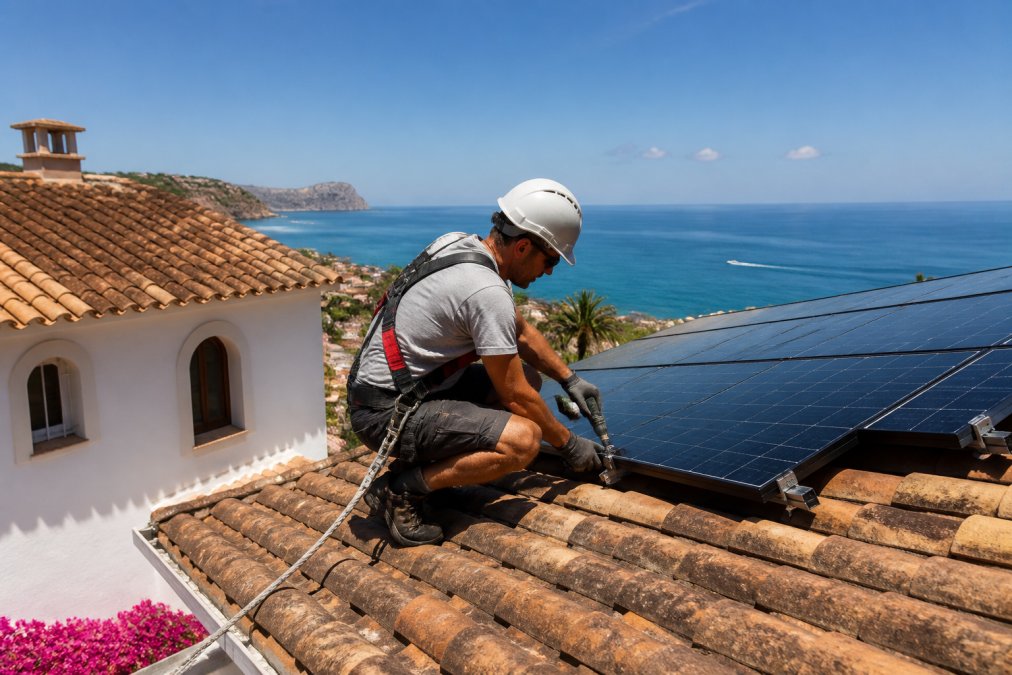
Roof type matters more here than most guides admit, because the coastal climate combines high summer temperatures with occasional heavy autumn rainfall. Panel efficiency drops as cell temperature rises, so mounting height and rear ventilation affect real-world output, not just theoretical yield.
| Roof Type | Suitability | Key Consideration |
|---|---|---|
| Pitched terracotta tile | Excellent | Standard hooks; check tile fragility on older roofs |
| Flat concrete tile | Excellent | Similar mounting; verify load capacity |
| Flat roof / azotea | Good | Ballasted or angled frames; orientation fully flexible |
| Tiled with complex hips | Moderate | More labour; careful string design needed |
| Shaded or tree-obstructed | Poor to moderate | Requires shading analysis before quoting |
A common mistake is accepting a quote without a shading study. Afternoon shade from a neighbouring tree or an adjacent building can remove a disproportionate share of production, and no panel specification compensates for it.
Tax Incentives for Solar Energy in Spain: What Owners Actually Claim
Tax incentives for solar energy in Spain operate at three levels: municipal, regional, and national. What you can claim depends on where the property sits and whether it is your habitual residence or a second home.
At municipal level, many councils offer a reduction on the IBI property tax for installations, typically for a fixed number of years, and some reduce the ICIO construction tax. Availability and percentage vary by town hall, so the only reliable check is your own council's ordinance.
At regional level, deductions against personal income tax have been introduced in several autonomous communities for self-consumption installations, sometimes with additional amounts for battery storage.
At national level, VAT on self-consumption equipment has been subject to reduced rates under specific conditions, and surplus generation can be compensated through the simplified compensation mechanism on your electricity bill.
Because rates, percentages, and eligibility windows change, we do not publish figures that may already be out of date. Check the current terms directly with the Spanish tax authority and your local council before you build a return model.
Solar Panel ROI for Rental Properties: Payback, Yield and Guest Appeal
Solar panel ROI for rental properties depends on three variables: the self-consumption ratio during occupancy, the compensation received for exported surplus, and the rental premium the property can command.
Payback for a well-sized system on a villa in this region commonly falls in the range of two to five years, but that range is wide for a reason. A property with a pool pump running daily through summer will absorb far more self-generated electricity than an apartment with no pool and no air conditioning running during daylight.
Three levers move the return most:
- Shift consumption into daylight hours. Run the pool pump, washing machine, and dishwasher during generation peaks.
- Size for base load, not peak load. Oversizing to cover a rare August spike lengthens payback.
- Add storage only where it earns its place. A battery makes sense when evening consumption is high and export compensation is low.
Guest appeal is the softest but real variable. A villa that advertises zero electricity cost for guests, or that supports EV charging, differentiates itself in a crowded short-let market. That is a rental-rate argument, not an energy-bill argument, and it should be modelled separately.
Financing a Solar Investment: Options That Keep Cash Flow Positive
Financing a solar investment works best when the monthly payment stays below the electricity cost it replaces. That is the whole principle. If the instalment is lower than the bill you no longer pay, the system is cash-flow positive from month one.
MiSolar offers innovative financing plans designed around that logic, and we structure them so the numbers are presented transparently before you commit. Ask for the total cost of credit, not just the monthly figure.
For owners who are only present part of the year, the calculation is different again. A property used for ten weeks generates savings concentrated in those weeks and compensation for the rest. Model it month by month rather than annually.
Common Mistakes That Wreck Solar Returns on Holiday Homes
The most damaging mistake is sizing the system for the property rather than for the occupancy. A 10 kWp array on a villa used ten weeks a year will export most of its production and deliver a far weaker return than a 4 kWp system that is almost fully self-consumed.
Other recurring errors we see:
- Ignoring the contracted capacity term. Reducing it alongside the installation is often where the fastest saving sits.
- Skipping the permitting process. Municipal works licences and grid connection approvals take time, and starting installation before they are granted creates legal exposure.
- Choosing on price alone. Solar hardware is broadly comparable, but design, mounting quality, and after-sales support are not. A quote that is significantly cheaper usually reflects a thinner design or a shorter support commitment.
- No monitoring. Without consumption monitoring, owners never learn whether the system is performing as designed.
The permitting timeline is the question we are asked most often. It varies by municipality and by the complexity of the grid connection, and we manage the entire process in-house precisely because the variation is where projects stall.
European Commission guidance on renewable energy self-consumption
The challenge with a holiday home is that the property's best financial decisions are made when you are not there to make them.
Frequently Asked Questions
Are solar panels a good investment for holiday homes?
Yes, if the property has decent roof exposure and you plan to keep it for at least five years. A solar investment cuts or eliminates electricity bills during the months you use the home, and the surplus can be sold back to the grid under Spain's self-consumption rules. For owners who rent the property out, lower energy costs make the villa more attractive to guests and can support higher weekly rates. Payback periods of 2 to 5 years are realistic when you size the system to actual consumption.
How do solar panels reduce operating costs for holiday rentals?
Air conditioning, pool pumps and hot water drive most of the electricity bill in a holiday rental. A correctly sized system covers those loads during daylight hours, and battery storage can shift surplus power into the evening. Owners typically see the standing charges drop to near zero for the months the property is occupied. Over a full rental season, that saving adds directly to net income rather than being absorbed by the utility company.
Can I claim tax deductions for solar installations on rental properties?
Spain offers several deductions at national and regional level, including relief linked to energy efficiency improvements and self-consumption. The exact percentage and eligibility rules depend on the autonomous community and the property's use. Because the rules change, you should confirm the current incentives for solar energy in Spain with a local tax adviser before signing a contract. MiSolar can supply the technical documentation your adviser will need.
Do I need planning permission for solar panels on a holiday home?
In most cases, rooftop solar on an existing dwelling does not require a full planning application, but you will usually need a minor works licence or a declaration of responsibility from the local council. If the property sits in a protected area or the panels are ground-mounted, the process is stricter. MiSolar manages the permitting paperwork in-house, so you do not have to chase the council yourself. Timelines vary by municipality, so ask for a schedule before work begins.