 blog
Reputable Turnkey Solar PV Alternatives: 2026 Guide
Table of Contents
- What a Turnkey Solar PV System Should Include
- Solar Installation Reviews: How to Verify an Installer's Reputation
- Solar Panel Installation Cost: Reading a Quote Without Guesswork
- Solar Panels With Battery Storage: When the Extra Spend Pays Off
- Your Solar Installation Quote Checklist
- Turnkey Solar Providers Compared: Scope, Warranty and Service
- Conclusion
- Frequently Asked Questions
Last Updated: October 22, 2026
What a Turnkey Solar PV System Should Include
A turnkey solar PV system is a complete package where one provider handles engineering, permits, procurement, installation and commissioning, so the homeowner signs off on a working system rather than coordinating trades. Split responsibility is where most residential solar projects go wrong. Research from the Spanish government's IDAE renewable energy agency confirms self-consumption has become the default route for new residential capacity, which makes the quality of the installer, not the panel brand, the deciding factor.
Engineering, Permitting and Grid Connection
Engineering starts with a load study and a roof survey, not a panel count. A proper design models your consumption profile, shading across seasons, roof structure and orientation, then sizes the array and inverter to match. In practice, the paperwork is what separates a real turnkey provider from a box-shifter: municipal building permits, the self-consumption registration with your distribution company, and the legalisation of the installation all sit with the provider. Ask who signs each document. If the answer is "you", it is not turnkey.
Procurement and On-Site Works
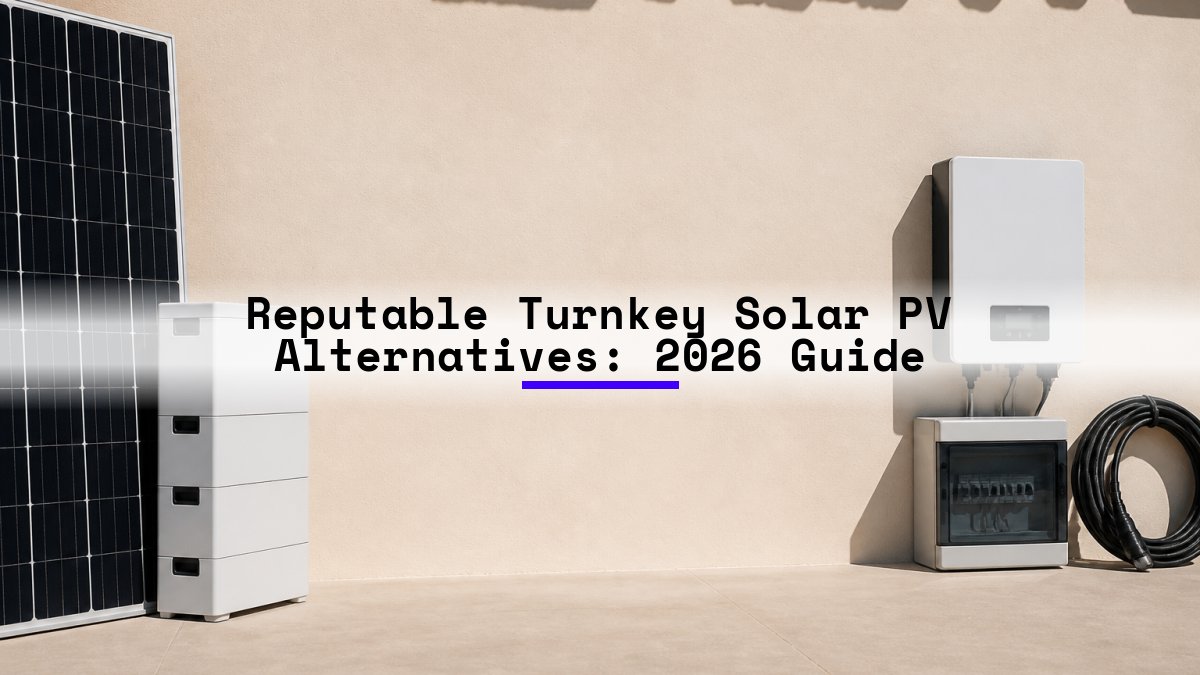
Procurement covers panels, inverter, mounting structure, cabling, protection devices and, where specified, battery storage. On-site works include roof mounting, DC and AC wiring, earthing, and commissioning with a performance test. A common mistake is accepting a quote that lists panels and inverter but omits scaffolding, structural reinforcement or the meter change. Those gaps become invoices later.
Solar Installation Reviews: How to Verify an Installer's Reputation
Solar installation reviews are only useful if you can verify who wrote them and what they actually bought. Most homeowners read star ratings and stop there. That is a mistake. A five-star review for a small hot water job tells you nothing about a full rooftop PV installation with battery storage.

The more reliable approach is to check the company against public Spanish records before you weigh a single review. Here is the sequence we would use on any installer, including us:
- Confirm the legal entity. Ask for the company's full legal name and NIF (tax identification number), then check it against the mercantile registry (Registro Mercantil) to confirm trading history, filed accounts and legal form. A trading name on a website is not the same as a registered company.
- Check the installation credential. Residential self-consumption installations must be commissioned and legalised by an installer that holds the relevant regional authorisation as an instalador eléctrico or empresa instaladora. Ask for the registration number and the region where it is held, then verify it with that region's industry or energy department. A credential from another region does not automatically cover your province.
- Confirm insurance in writing. Ask for the current public liability policy and the workmanship guarantee certificate, and check the policy is in force for the dates of your works. A certificate of insurance is not the same as a policy schedule.
- Request two references from the last twelve months in your area, and call them. Ask specifically about after-sales response times, who handled the grid connection paperwork, and whether the final invoice matched the quote.
- Read the negative reviews first. How a company responds to a complaint reveals more than a hundred five-star ratings. Look for patterns: repeated delays on grid connection, unexpected extra invoices, or slow response to inverter faults.
- Check the complaint trail. Consumer complaints in Spain can be escalated through the regional consumer authority (consumo) and, for cross-border or online issues, through the European Consumer Centre network. Ask the installer whether any open complaints exist and how they were resolved.
A company with 300+ installations and a 5.0 rating earned over years is a different proposition from a new entrant with fifty reviews collected in three months. Volume plus longevity is the signal, but only after the registry, credential and insurance checks come back clean.
Solar Panel Installation Cost: Reading a Quote Without Guesswork
Solar panel installation cost depends on system size, roof complexity, battery inclusion and the amount of electrical work required, so any single figure quoted without a site survey is a guess. Pricing depends on your consumption, roof and specification, and we quote after the survey.
When you compare quotes, normalise them. Ask every installer for the same four lines:
| Quote line | What to check | Red flag |
|---|---|---|
| System size and generation estimate | kWp, annual kWh, shading assumptions | No yield figure at all |
| Equipment schedule | Panel and inverter make and model | "Equivalent" or unnamed brands |
| Scope of works | Permits, grid connection, scaffolding, meter | Exclusions buried in small print |
| Warranty terms | Years, what is covered, who honours it | Verbal promises only |
A quote that is €2,000 cheaper usually differs in one of those four lines. Find out which before you decide.
Solar Panels With Battery Storage: When the Extra Spend Pays Off
Solar panels with battery storage make financial sense when your household consumes most of its electricity in the evening, or when grid reliability matters to you. Without a battery, surplus energy is exported and compensated at a lower rate than the retail price you pay. A battery lets you store midday generation and use it at night.
The decision comes down to your consumption pattern:
- Daytime-heavy household, someone home all day: battery adds less value; size the array to consumption and export the rest.
- Evening-heavy household, out at work: battery captures the mismatch and typically pays back faster.
- Holiday home used part of the year: a smaller battery plus monitoring usually beats a large one that sits idle.
- Villa with pool, air conditioning and EV charging: battery storage plus load management is where the economics work hardest.
Ask for the battery's usable capacity in kWh, its round-trip efficiency and its cycle warranty. A quoted "10 kWh battery" with 90% usable capacity is a 9 kWh battery in practice.
Your Solar Installation Quote Checklist
Use this checklist before you sign anything. It is the same list we walk clients through.
- Site survey completed, including roof structure and shading analysis
- Annual consumption reviewed from at least twelve months of bills
- System size in kWp and estimated annual generation in kWh stated
- Panel make, model, wattage and warranty period named
- Inverter make, model and warranty period named
- Battery capacity, chemistry and cycle warranty stated (if included)
- Mounting system and roof fixing method specified
- Scaffolding, crane or access costs included
- Municipal permit and grid connection handled by the provider
- Self-consumption registration included
- Commissioning test and monitoring setup included
- Workmanship guarantee period in writing
- Payment schedule tied to milestones, not full upfront
- After-sales contact and response commitment stated
Turnkey Solar Providers Compared: Scope, Warranty and Service
Turnkey solar providers differ far more in scope and after-sales service than in the hardware they fit. Panels and inverters come from a handful of manufacturers, so the real variable is who takes responsibility when something goes wrong in year four, and whether that responsibility is written down.
We group providers into three types, which is a distinction most comparison guides miss:
Full-service turnkey installers handle engineering, permitting, procurement, installation and post-commissioning support in-house. One contract, one point of contact, one party accountable for the whole system. MiSolar operates this way, with 300+ installations and a 5.0 rating, and we manage the municipal and grid paperwork ourselves rather than handing it back to the homeowner. Alongside Residential Solar Installation and Solar PV Installation Services, we also cover the add-ons that often come up once a system is in, from EV charger installation to a Solar Pool Heater for villas with a pool.
Subcontracted installers sell the project and hire third-party crews for the roof work. The sales company and the crew that actually drilled your roof are different businesses. When a leak appears, accountability gets murky.
Equipment suppliers with installation partners sell a kit and recommend a local fitter. Cheapest on paper, but the design, the permit and the warranty are split across parties.
| Provider type | Scope | Warranty holder | Best for |
|---|---|---|---|
| Full-service turnkey | Design to after-sales | Single provider | Homeowners wanting one accountable party |
| Subcontracted | Sales in-house, works outsourced | Split | Rarely the best choice |
| Supplier plus fitter | Equipment only | Manufacturer only | Confident DIY-adjacent buyers |
The Four Comparison Lines That Actually Matter
Rather than compare marketing claims, normalise every provider against the same four lines. This is the structure we would use to compare any two turnkey offers side by side.
**1.
2. Workmanship and equipment warranty terms. Separate the two. The equipment warranty comes from the manufacturer and is typically 10-25 years for panels and 5-12 years for inverters, depending on the model.
3. Post-installation service. Ask what happens after commissioning: is monitoring included, for how long, and who reviews the alerts? What is the response time commitment for a fault, and is it in the contract?
4. Regional coverage and suitability. Provider availability, solar yield, roof conditions and local rules vary across the country.
Official EU guidance on consumer rights and guarantees sets the baseline for what a warranty must cover.
Conclusion
The hard part of going solar is not choosing a panel. It is finding a provider that will still answer the phone when the inverter faults in year five, and that has the paperwork, the permits and the warranty in one place. MiSolar manages engineering, permitting, procurement and on-site works in-house, designs each system around your actual consumption and roof, and supports you after commissioning with monitoring setup and performance checks. Get a quote and see the full scope in writing before you commit.
Frequently Asked Questions
What should a turnkey solar installation quote include?
A turnkey quote should list the system size in kWp, panel and inverter models, mounting hardware, and whether battery storage is included. It needs to state who handles the licencia de obra, the boletín eléctrico, the legalisation file and the grid connection with the distributor. Ask for the warranty terms on panels, inverter and workmanship separately, plus a named post-installation contact. If a figure is missing, request it in writing before signing anything.
How can I check whether a solar installer is reputable?
Ask for the company's registration details and confirm them, then request two or three recent installations you can visit or speak to the owners about. Check that the quote names the equipment and the warranty holder, not just a total figure. Look at how quickly they answer technical questions before you pay anything. A provider that manages engineering, permits and on-site work in-house gives you one point of responsibility if something fails years later.
Is it worth getting solar panels in Spain?
For a home with daytime consumption and a suitable roof, self-consumption usually pays back faster than most home improvements. The economics depend on your consumption profile, roof orientation and shading, and how much surplus you export. Battery storage changes the maths again by shifting generation into the evening. Ask for a yield estimate in kWh per year and a written payback range rather than a single headline number.
Do solar installers handle permits and grid connection?
The good ones do. A turnkey provider should manage municipal permits, the legalisation of the installation, and the connection contract with the distribution company, plus the paperwork for any subsidy or tax deduction you qualify for. Confirm in writing which of these are included and which carry separate fees. If permits sit outside the quote, ask who coordinates them and what the expected timeline is.