
 ultimate-guide
Costa Blanca Solar Permitting Process: 2026 Guide
Table of Contents
- Why Solar Permitting on the Costa Blanca Is Different
- The licencia de obra for solar panels: What Your Municipality Requires
- How Long Does Solar Permitting Take? Realistic Timelines
- Best Roof Types for Solar Panels in Javea and Surrounding Areas
- Common Delays and How to Avoid Them
- How MiSolar Manages the Entire Permitting Process for You
- Frequently Asked Questions
Last Updated: September 25, 2026
Why Solar Permitting on the Costa Blanca Is Different
Solar permitting on the Costa Blanca is a municipal process, not a regional one. Each town hall applies its own interpretation of the licencia de obra, its own documentation list, and its own timelines. That single fact explains most of the frustration homeowners run into when they try to manage the costa blanca solar permitting process themselves.
At MiSolar, we have completed more than 300 installations across the Costa Blanca North, and the pattern is consistent: the technical work is rarely the bottleneck. The paperwork is.
Three things make this region distinct:
- Municipal fragmentation. Jávea, Dénia, Moraira, Benitachell and Teulada each run their own urban planning department. A document set accepted in one town can be rejected in the next.
- Protected and rustic land. Large parts of the northern Costa Blanca fall under some form of planning protection, which adds a layer of review before any licence is granted.
- Second-home ownership. Many applicants live abroad for most of the year, which slows every stage that requires a signature or a site visit.
There is a fourth factor that catches people out. Since the Spanish government's Royal Decree 244/2019 on self-consumption, the legal framework for self-consumption has been clear at national level. Municipalities have no power to ban solar outright. What they can do is control how the installation is documented, sited and declared.
The licencia de obra for solar panels: What Your Municipality Requires
The licencia de obra is the local building permit that authorises your solar installation. Most Costa Blanca municipalities require one for rooftop solar, although smaller systems on detached villas are sometimes handled through a simplified declaration instead. The only reliable way to know is to ask your own town hall's urbanismo department.
- Autorización de la comunidad de propietarios if your property sits within a community with shared roofs or facades
- Compatibility report if the building falls within a protected or rustic zone
- Grid connection approval from your distribution company, which runs in parallel with the municipal process
Documents You Will Need for the Application
Documentation requirements vary by municipality, but the core set is consistent across the region. Expect to provide:
- Memoria técnica (technical report) signed by a qualified engineer, covering system design, structural loading and electrical layout
- Plano de situación showing the property and the proposed panel placement
- Fotografías of the roof and the intended mounting area
- Escritura de propiedad or equivalent proof of ownership
- Último recibo del IBI (property tax receipt)
- DNI or NIE of the applicant
- Presupuesto detallado from the installer, itemised
- Certificado de eficiencia energética in some municipalities
- Authorisation from the community of owners, where applicable
How Long Does Solar Permitting Take? Realistic Timelines
Solar permitting typically takes between two and six months on the Costa Blanca, depending on your municipality and whether your property sits in a protected zone. There is no universal figure, and anyone who quotes you one is guessing.
| Stage | Typical Duration | What Slows It Down |
|---|---|---|
| Document preparation | 2-4 weeks | Missing IBI receipt, unsigned power of attorney |
| Municipal submission and review | 4-12 weeks | Incomplete file, protected land status |
| Technical inspection | 2-4 weeks | Access issues, roof condition |
| Grid connection approval | 2-6 weeks | Distribution company workload |
| Registration and final declaration | 2-4 weeks | Mismatch between approved and installed system |
Best Roof Types for Solar Panels in Javea and Surrounding Areas
The best roof types for solar panels in Javea and the surrounding towns are pitched terracotta tile roofs with a south or south-west orientation and a pitch between 15 and 35 degrees. These dominate the local villa stock and are close to ideal for panel mounting.
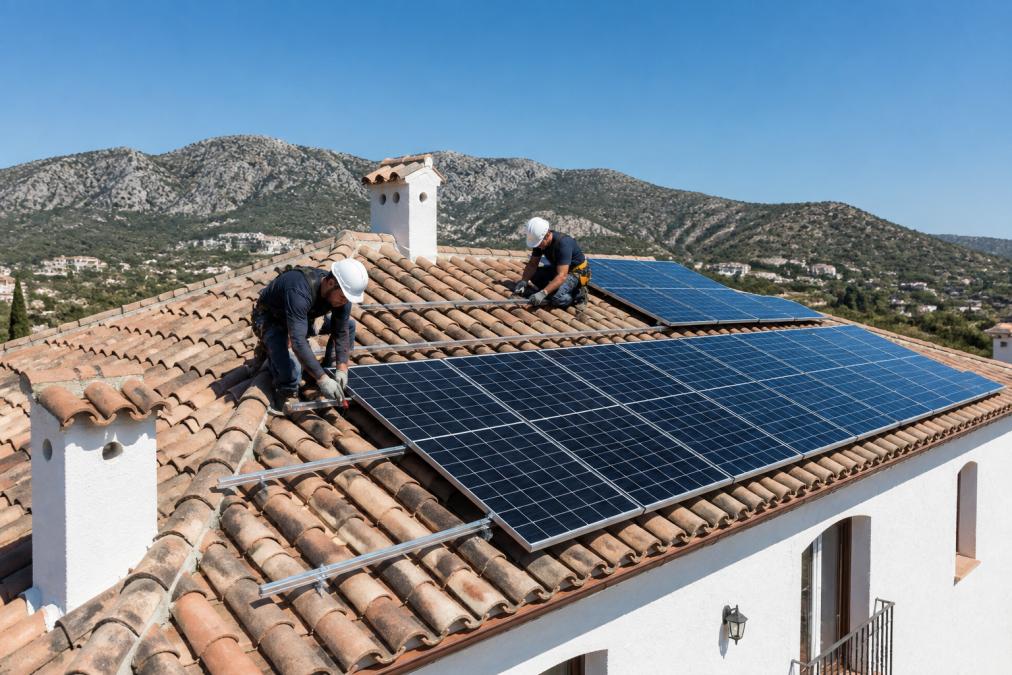
- Pitched terracotta tile. The standard local roof. Panels mount on rails fixed to the rafters, with tiles lifted and replaced around the brackets. Straightforward, but the tile type matters: some older, brittle tiles crack during lifting and need replacing.
- Flat roofs (azotea). Common on newer builds. Panels mount on ballasted or anchored frames, and the tilt can be set to whatever angle suits the site. Slightly more hardware, more flexibility.
- Sandwich panel or metal roofs. Less common residentially but found on some outbuildings. Mounting is quick, but the fixings must be specified for the panel material.
- Shaded or partially shaded roofs. Trees, neighbouring buildings and chimneys all cut yield. Modern systems with optimisers or micro-inverters handle partial shading far better than older string arrangements. If your roof is shaded in the afternoon, that is a design problem, not a dealbreaker.
Common Delays and How to Avoid Them
The most common cause of delay is a mismatch between the approved memoria técnica and the installed system. If the engineer specifies one inverter and the installer fits another, the file can be rejected at the final inspection stage, after the work is done.
Other frequent problems, and how to sidestep them:
- Protected land status discovered late. Check your land classification before you commission any design work. It is a five-minute question at the town hall and can save months.
- Community of owners not informed. If your roof is shared, get written approval early. A verbal agreement is worthless at the urbanismo desk.
- No power of attorney for non-resident owners. Arrange it before you travel home. Signing remotely is possible but slow.
- Incomplete grid application. Your installer should handle this. If they ask you to do it, ask why.
- Chasing the cheapest quote. A quote that omits the memoria técnica, the grid application or the final registration is not cheaper. It is incomplete, and you will pay for the missing parts later.
How MiSolar Manages the Entire Permitting Process for You
MiSolar handles the permitting process end to end, in-house, from the initial memoria técnica through to the final municipal registration. Nothing is subcontracted to a third party who disappears once the invoice clears.
What that looks like in practice:
- We prepare the memoria técnica and the full municipal file, tailored to your specific town hall's requirements
- We manage the grid connection application with your distribution company
- We handle the technical inspection and the final registration
- We design around your actual roof, orientation and shading, rather than applying a template
- We can integrate battery storage, EV charging and heat pump systems into the same project, so the permits cover the whole installation rather than being reopened later
Frequently Asked Questions
Do I need a building permit for solar panels on my villa?
Yes, most municipalities require a licencia de obra for solar installations. This applies to both ground-mounted and roof-mounted systems, though some smaller installations may qualify for a simplified declaration. The exact requirement depends on your town hall's planning rules and the size of your system. MiSolar handles the entire application for you, ensuring you meet local requirements without delays.
How long does solar permitting take in this region?
The permitting process varies in duration, depending on your municipality's workload and whether additional documentation is requested. Some town halls process applications faster than others. MiSolar's local experience means we submit complete, error-free applications that avoid common hold-ups, so your installation can proceed as quickly as possible.
What documentation is required for a solar installation licence?
You will usually need a technical project or memory signed by a qualified engineer, a site plan showing panel locations, proof of property ownership, and your NIE or DNI. Some municipalities also ask for a declaration of no environmental impact. MiSolar prepares all technical documents in-house, so you only need to provide basic personal details and we manage the rest.
Are there specific municipal regulations for solar panels in my town?
Yes, each town hall has its own rules on visual impact, roof integration, and heritage protection. For example, properties in protected areas may face stricter conditions. MiSolar knows the specific requirements across the region and designs systems that comply from the start, avoiding rejected applications or costly redesigns.
Do I need to notify my community of owners before installing solar?
If you live in a community of owners, you should inform them before installing solar panels on shared roofs or facades. Spanish horizontal property law allows solar installations, but you may need prior approval if the system affects common elements. MiSolar can advise on the correct procedure and provide documentation to support your request.
What is the role of the 'licencia de obra' in solar installations?
The licencia de obra is the municipal permit that authorises construction or installation work. For solar panels, it confirms your project meets local planning and safety rules. Without it, your installation could be deemed illegal and you may face fines. MiSolar manages the entire licencia de obra solar panels process, from application to final approval.
What happens if my roof is shaded or not ideal for solar?
Shading from trees or neighbouring buildings can reduce output, but it does not rule out solar. MiSolar uses design tools to map shading patterns and optimise panel placement. In some cases, micro-inverters or optimisers can help. We will assess your roof honestly and recommend the best solution for your property.
Can MiSolar handle the permitting if I am not in the country?
Yes, MiSolar manages the full process remotely. We prepare all documents, submit them to the town hall, and keep you updated by email or phone. You do not need to be present for the application or the installation. Our team acts as your local representative, ensuring everything is completed correctly.