 Ultimate guide
Smart Energy Management for Large Villas: A Complete Guide
Last Updated: November 7, 2026
Quick Summary
Smart energy management for large villas is the coordinated control of generation, storage and consumption so energy is produced, stored and used at the lowest sensible cost. It replaces independent systems with one control layer that reads production, storage and consumption in real time and decides where each kilowatt-hour goes.
- Every villa system is built from four layers: generation, storage, loads and control.
- Circuit-level metering on pool, air conditioning, hot water and kitchen turns monitoring into a decision tool.
- Size the battery to evening and night demand plus a reserve; still full at midnight means oversized.
- Pool pumps are the easiest win because filtration can run in a fixed daily window.
- Any payback figure quoted before a consumption survey has been done is a guess, not a calculation.
Table of Contents
- What Smart Energy Management Means for a Large Villa
- How a Home Energy Management System for Villas Works
- Villa Energy Monitoring: Making Consumption Visible
- Solar Self-Consumption in Spain: The Rules That Shape Your System
- Solar Battery Storage for Villas: Sizing, Backup and Limitations
- Controlling HVAC, Heat Pumps and Pool Pumps Intelligently
- Sizing and Designing a System for Villa-Scale Demand
- Costs, Payback and What Drives the Economics
- Common Mistakes and Bad Advice to Ignore
- Getting Your Villa System Designed and Installed
- Frequently Asked Questions
What Smart Energy Management Means for a Large Villa
Smart energy management is the coordinated control of generation, storage and consumption in a property so that energy is produced, stored and used at the lowest sensible cost. For a large villa, it replaces a set of independent systems with one that makes decisions across all of them.
A property with a pool, several air-conditioning zones and a large hot-water demand can spend far more than its owners expect, often because nothing coordinates those loads. A villa is not a bigger house.
That is the core argument of this guide: smart energy management for large villas is a sizing and control problem before it is a technology problem. Once the system is sized around the villa’s actual loads, smart energy monitoring helps turn that sizing decision into day-to-day control by showing when and where energy is being used.
How a Home Energy Management System for Villas Works
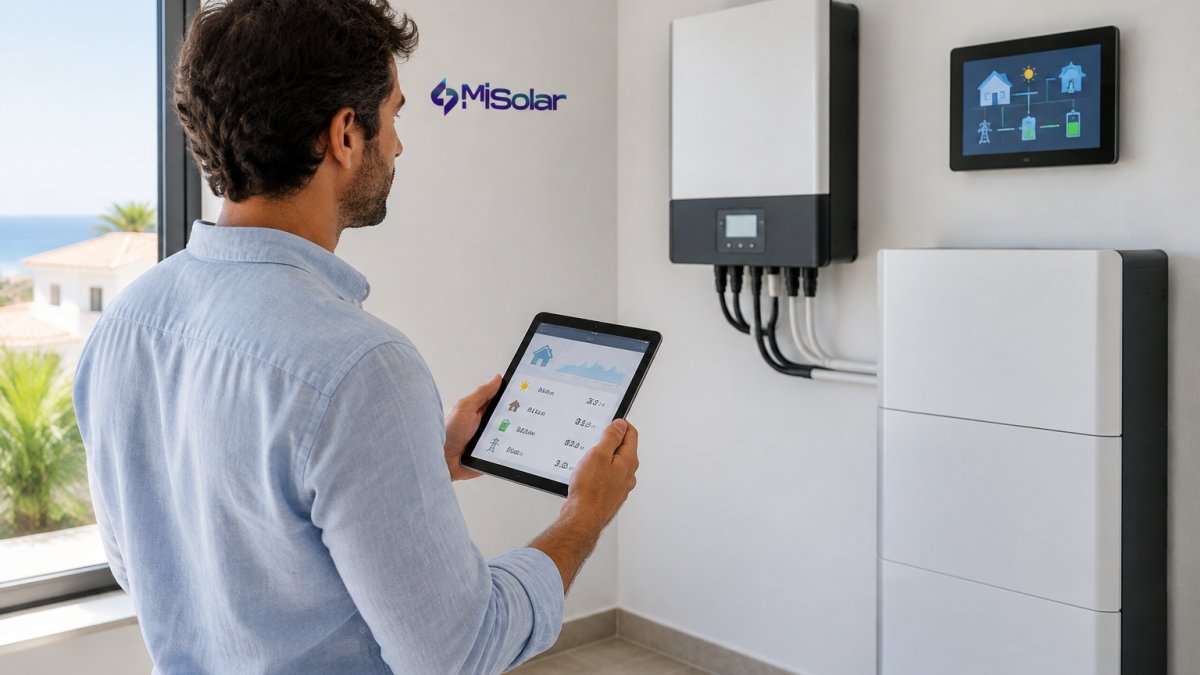
A home energy management system for villas is a control layer that reads production, storage and consumption in real time and decides where each kilowatt-hour goes. It sits above the inverter, the battery and the appliances, and it is only as good as the data it receives.
The practical difference between a basic monitoring app and a real management system comes down to whether it can act. Monitoring tells you the pool pump ran during the expensive window. Management stops it.
The Four Layers: Generation, Storage, Loads and Control
Every villa system is built from four layers, and weak design in any one of them caps the performance of the rest:
- Generation: the photovoltaic array, sized to the villa's daytime baseline rather than its peak.
- Storage: the battery, sized to evening and night demand plus a reserve for outages.
- Loads: pool pumps, air conditioning, hot water, EV charging and appliances.
- Control: the logic that sequences loads against production and tariff periods.
A well-sized array with no load control still exports midday energy and buys it back in the evening.
Villa Energy Monitoring: Making Consumption Visible
Villa energy monitoring is the metering of individual circuits and major appliances so that consumption can be attributed rather than guessed. Without it, every recommendation is an assumption.
A common mistake is monitoring only the whole-house supply. That tells you the villa used 40 kWh yesterday; it does not tell you the pool pump accounted for a third of it. Circuit-level metering on the pool, air conditioning, hot water and kitchen circuits is what turns monitoring into a decision tool.
If you want to understand how a system can be managed when you are not in the property, our guide to managing solar energy remotely from anywhere covers the remote-control side in detail. For holiday-home owners in Jávea, that capability matters more than any dashboard: most of the year, nobody is there to notice a fault.
Solar Self-Consumption in Spain: The Rules That Shape Your System
Solar self-consumption in Spain is governed by Royal Decree 244/2019, which sets out two routes: without surplus, where production never exceeds on-site demand, and with surplus, where excess is exported to the grid. The distinction decides your paperwork, your metering and your economics.
Surplus installations require the appropriate grid access and metering arrangements, and that process runs through your distributor.
Sizing an array to maximise export rather than self-consumption is an expensive design choice, because export compensation is not the point of the system.
Current national rules and municipal permitting requirements are set out by IDAE, Spain's energy diversification institute and by the Spanish government's official state gazette. Confirm the current position with your installer before signing anything, because municipal processing varies considerably between towns in Alicante province.
Solar Battery Storage for Villas: Sizing, Backup and Limitations
Solar battery storage for villas is sized around evening and night consumption, not around the array's total output. A battery that fills by noon and empties by nine in the evening is correctly sized; one that is still full at midnight is too large.
Three limitations deserve honesty. Batteries have a usable depth of discharge below their nominal capacity, so a stated figure is not the figure you can draw. Backup power requires the inverter and the protected circuits to be designed for it from the start.
If you are sizing storage for a villa, our solar battery storage and backup power service sets out how we approach it. The honest answer for many properties is that the pool and hot water should be shifted into daylight hours first, and the battery sized afterwards.
Controlling HVAC, Heat Pumps and Pool Pumps Intelligently
Heating, cooling and pool circulation are the three largest controllable loads in a villa, and all three can be moved into the hours when your own generation is highest. That is the whole principle.
Air conditioning in a villa is usually zoned, and zoning is what makes control worthwhile: cooling four empty bedrooms because one thermostat calls for it is pure waste. Intelligent control runs each zone against occupancy and against production. Heat pumps and aerothermal systems work best when they heat water in the middle of the day rather than at peak tariff. Pool pumps are the easiest win of all, because filtration can run in a fixed daily window with almost no loss of water quality.
We install air source heat pumps and variable speed pool pumps precisely because both convert an inflexible load into a schedulable one. A variable-speed pump run at low speed for longer costs materially less than a fixed-speed pump run for a short period.
Sizing and Designing a System for Villa-Scale Demand
Villa-scale sizing is best started from a full year of consumption data, split into day and night, summer and winter, occupied and unoccupied.
A practical sizing sequence for a villa looks like this:
- Establish the annual and seasonal load profile. Pull 12 months of distributor data if available, then break it down by season. A villa typically peaks in summer because of air conditioning and pool circulation, with a secondary winter peak if a heat pump or electric heating is used. The annual total matters less than the shape.
- Separate controllable from fixed loads. Pool pump, hot water, EV charging and cooling are schedulable; refrigeration, standby and security are not. The schedulable share is what a management system can move into daylight.
- Size the array to the daytime baseline plus the shifted load. One approach is to size photovoltaic capacity so that midday production covers the villa's baseline plus the pool and hot-water load moved into the solar window, rather than sizing to the annual total.
- Size the battery to evening and night demand plus a reserve. The battery should cover the villa's evening and overnight consumption, lighting, cooling in summer, refrigeration, standby, with a margin for a grid outage. A battery that is still full at midnight is oversized; one that empties by 21:00 is correctly sized.
- Size the heat pump and hot water to the building, not to the array. Aerothermal and air-source heat pumps should be selected on the villa's heat loss and hot-water demand, then scheduled to run in the middle of the day. Sizing the heat pump to the solar array rather than to the building is a common error.
- Size the pool pump and filtration to water quality, then schedule it. Variable-speed pumps allow longer, lower-speed filtration that costs materially less than a short high-speed run. The filtration window should sit inside the solar window wherever possible.
- Size EV charging to the vehicle and the supply. A single 7.4 kW charger is typical for a villa; two vehicles or a three-phase supply change the calculation. Charging should be scheduled against production and tariff periods, not left to chance.
Shading deserves its own consideration. Afternoon shade from neighbouring trees or a hillside reduces yield, and it affects the array layout and string design. A designer who models shading properly will split strings and use optimisers where needed.
Sizing an array to the annual consumption figure rather than to the daytime and shifted load is a common villa design error, and it can be expensive to correct after installation.
If you want to understand how a system can be managed when you are not in the property, our guide to managing solar energy remotely from anywhere covers the remote-control side in detail. For holiday-home owners in Jávea, that capability matters more than any dashboard: most of the year, nobody is there to notice a fault.
A practical villa sizing sequence runs from the load profile through to EV charging.
| Step | What to do | Key detail |
|---|---|---|
| 1 | Establish annual and seasonal load profile | Use 12 months of distributor data; shape matters more than total |
| 2 | Separate controllable from fixed loads | Pool, hot water, EV charging and cooling are schedulable |
| 3 | Size array to daytime baseline plus shifted load | Not to the annual total |
| 4 | Size battery to evening and night demand plus reserve | Still full at midnight means oversized |
| 5 | Size heat pump and hot water to the building | Not to the solar array |
| 6 | Size pool pump and filtration to water quality | Variable-speed pumps allow longer, lower-speed filtration |
| 7 | Size EV charging to the vehicle and the supply | A single 7.4 kW charger is typical for a villa |
Costs, Payback and What Drives the Economics
Costs for a villa system depend on array size, storage capacity, the complexity of load control and the state of the existing electrical installation. Pricing depends on your property, so please request a quote for current figures. What we can do is set out the cost structure and the variables that decide whether a system pays back.
Indicative installed-cost ranges for a Costa Blanca North villa. These are broad ranges for orientation only, in EUR, and exclude any property-specific civil works or electrical upgrades:
Costs vary with equipment choice, roof access, cable runs and whether the existing distribution board needs replacing.
What drives payback. Payback is less about the equipment and more about four variables: how much of your generation you consume yourself, what you were paying per kilowatt-hour before, how much of your load you can shift into daylight, and how much the system costs after any applicable deductions. A villa that self-consumes most of its production pays back far faster than one that exports it. A pool and hot water shifted into the solar window can lift self-consumption substantially without any additional equipment.
Spanish incentives and deductions. Support schemes in Spain change with each government and each region, and the Valencian Community has run its own programmes alongside national ones. Rather than quote a figure that may be out of date by the time you read this, confirm the current position with your installer and check the IDAE, Spain's energy diversification institute and the Spanish government's official state gazette for the rules in force.
Operating economics for a seasonal villa. For a villa that is empty for months at a time, the economics still work, but the case rests on eliminating standing charges and covering the loads that run year-round, pool filtration, refrigeration, security, irrigation, rather than on offsetting a large occupied-season bill.
For a worked breakdown of current installation figures, see our solar panel installation cost guide.
Watch out: any payback figure quoted before a consumption survey has been done is a guess, not a calculation, and it is usually optimistic.
Common Mistakes and Bad Advice to Ignore
A common mistake is buying equipment instead of a design. The layout, string design, load sequencing and commissioning matter as much as the components.
Here is what we would tell a friend to ignore:
-
"Bigger is better." An oversized array with no load control exports cheap and buys back dear.
-
"The battery will handle it." Storage cannot compensate for a system that was never designed around consumption.
-
"Monitoring is a nice extra." Without circuit-level data you cannot verify performance or diagnose a fault.
Watch out for any proposal that arrives without a consumption analysis attached. If the quote came before the survey, it is a price, not a design.
Getting Your Villa System Designed and Installed
A villa system is best designed by the people who will install and support it. MiSolar manages engineering, permitting, procurement and on-site works in-house, so one team is accountable from survey to commissioning.
We have completed more than 300 installations and hold a 5.0-star rating. Post-commissioning support, including monitoring setup and performance checks, is part of the service.
If you are weighing up a system for a villa in the Costa Blanca North, get in touch with MiSolar to discuss your property and request a quote.
A villa with a pool, zoned air conditioning and a large hot-water demand benefits from a design that coordinates generation, storage and loads, along with an installer who provides ongoing support. MiSolar provides full-service solar installation across the Costa Blanca North, with in-house engineering, permitting and procurement, tailored system design for your occupancy pattern, and post-commissioning monitoring and performance checks. Get started with MiSolar and find out what your villa can realistically generate, store and save.
Frequently Asked Questions
What is smart energy management for a large villa?
It is the coordinated control of how a villa generates, stores and uses electricity. Solar panels produce power, a battery stores the surplus, and a home energy management system decides when the pool pump, air conditioning, hot water and EV charger run so they use that power instead of grid supply. For a large villa with high consumption, the goal is to raise self-consumption, cut waste and keep backup power available when the grid fails.
Can a home energy management system coordinate solar panels and batteries?
Yes. The controller reads generation and consumption in real time and decides whether surplus solar should charge the battery, feed a flexible load such as the pool pump, or be exported. It can also protect a reserved backup circuit during an outage. The value depends on correct configuration at commissioning, so ask your installer to show you the load-priority settings and confirm the battery reserve is set for your actual outage risk.
Is a battery worthwhile for a villa with solar panels in Spain?
It depends on your consumption pattern. A battery pays off most when the villa is occupied in the evening, when air conditioning and pool pumps run after sunset, or when you want backup power. If the property is empty for long stretches, the case is weaker because there is little evening load to absorb stored energy. Sizing matters more than capacity: an oversized battery adds cost without raising self-consumption.
How can I monitor energy use in a holiday home when I am away?
Villa energy monitoring platforms report consumption remotely, so you can see whether a pool pump, irrigation system or air conditioning unit is running unexpectedly. Set alerts for abnormal consumption and for generation dropping to zero, which usually points to an inverter fault or a tripped breaker. Remote visibility turns a problem that would run for weeks into one you resolve within a day.
What should I consider when choosing a home energy management system for a villa?
Check that it supports your inverter and battery brands, that it can control high-load circuits such as pool pumps and air conditioning, and that it keeps working if the internet drops. Ask about data ownership and remote access security. Also confirm local support: a system nobody can service on the Costa Blanca North becomes a liability. MiSolar configures monitoring and runs performance checks after commissioning.