
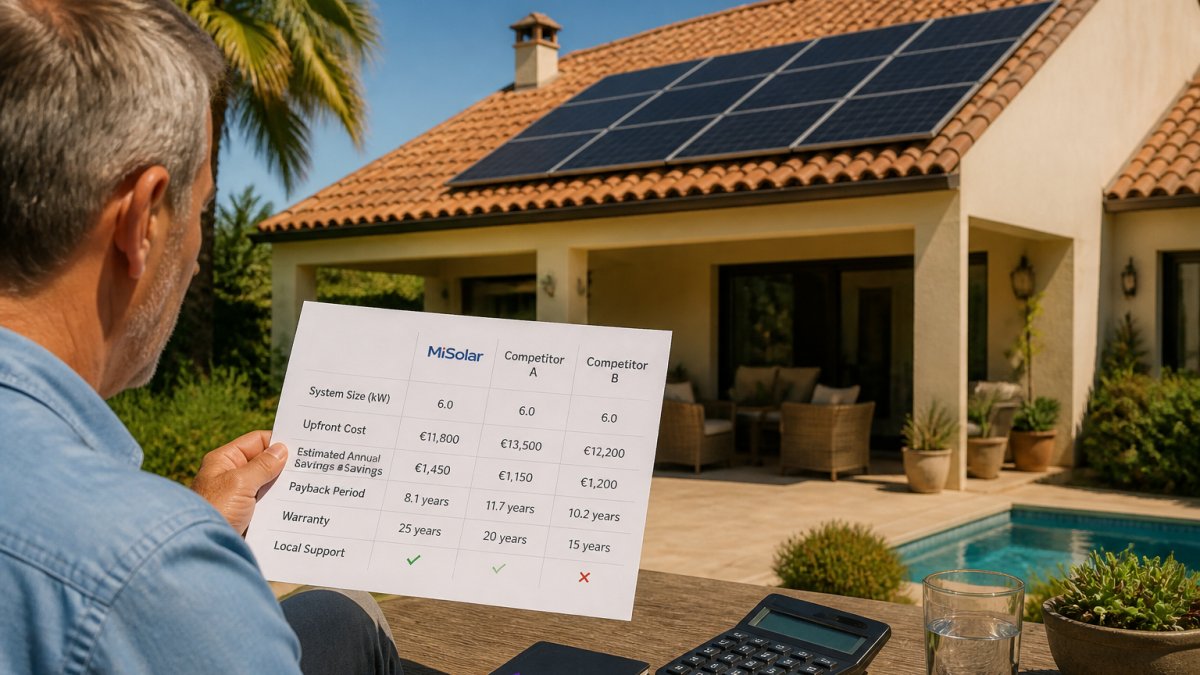
 ultimate-guide
Is Solar Worth It in Spain? A 2026 Cost-Benefit Guide
Table of Contents
- What Decides Whether Solar Pays Off
- Solar Panel Payback Period: What to Expect
- Solar Installation Engineering Design and Shading Solutions
- Which Solar Systems Suit Different Homes
- Government Incentives and Grants for Solar
- Reliable Installers That Handle Engineering and Design
- Conclusion
- Frequently Asked Questions
Last Updated: September 30, 2026
What Decides Whether Solar Pays Off
Whether solar is worth it in Spain comes down to three variables: how much sun your roof actually receives, what you currently pay for electricity, and how much of that consumption you can shift into daylight hours. Get those three right and the sums tend to work strongly in your favour. Get them wrong, and even a well-installed system underperforms.
This guide from MiSolar covers the full picture for homeowners weighing up an investment in 2026, from sunlight hours and payback to the engineering work that decides whether shading quietly eats your returns.
The Costa Blanca North sits in one of the better solar regions in Europe, with long summers and mild winters keeping panels productive year-round. According to the European Commission's PVGIS solar radiation database, the region receives some of the highest annual irradiation values in the country. That is the good news. The complication is that irradiation maps describe an average roof, not yours.
Sunlight Hours and How They Affect Output
A coastal villa typically sees more than 2,700 hours of sunshine a year, but usable production depends on orientation, tilt, and what stands between your roof and the sun. South-facing arrays at around 30 degrees of tilt capture the most annual energy; east and west arrays produce less overall but spread generation across the day, which can suit households that use more power in the morning and evening.
Electricity Prices and Self-Consumption
Self-consumption is the metric that matters most. Every kilowatt-hour you use directly from your own roof is a kilowatt-hour you do not buy at retail rates, and retail rates have climbed sharply over the past decade. According to Red Eléctrica de España's system data, wholesale and retail electricity costs remain well above the levels of five years ago. The practical consequence: the more of your daytime consumption you can cover, the faster the system repays itself.
Solar Panel Payback Period: What to Expect
The solar panel payback period is the time it takes for your accumulated savings to equal what you paid for the system. For a well-designed residential array with high self-consumption, most homeowners in this region break even in roughly 2 to 5 years, with battery storage pushing that figure toward the upper end.
Three factors move that number more than anything else:
- Self-consumption ratio. Households running pool pumps, air conditioning, and appliances during daylight hours capture far more value than those who export everything.
- System sizing. An oversized array exports cheap and buys expensive. A right-sized array matches your actual consumption profile.
- Installation quality. Poor orientation, undersized cabling, or unmanaged shading can cut real-world output well below the design estimate.
Solar Installation Engineering Design and Shading Solutions
Solar installation engineering design is the process of translating a specific roof, its orientation, its shading profile, and a household's consumption pattern into a system that performs as predicted. It is the difference between a quote and a design.
Shading is where most installations are won or lost. A chimney, a dormer, a neighbouring tree, or a cable mast can knock out a disproportionate share of output because panels are wired in strings: shade on one panel drags down the performance of every panel on that string.
How Shading Is Measured and Managed
A proper shading analysis maps the sun's path across the year against every obstruction on and around the roof, not just a snapshot at midday. Tools such as horizon profiling and irradiance modelling produce hour-by-hour production estimates rather than a single annual figure.
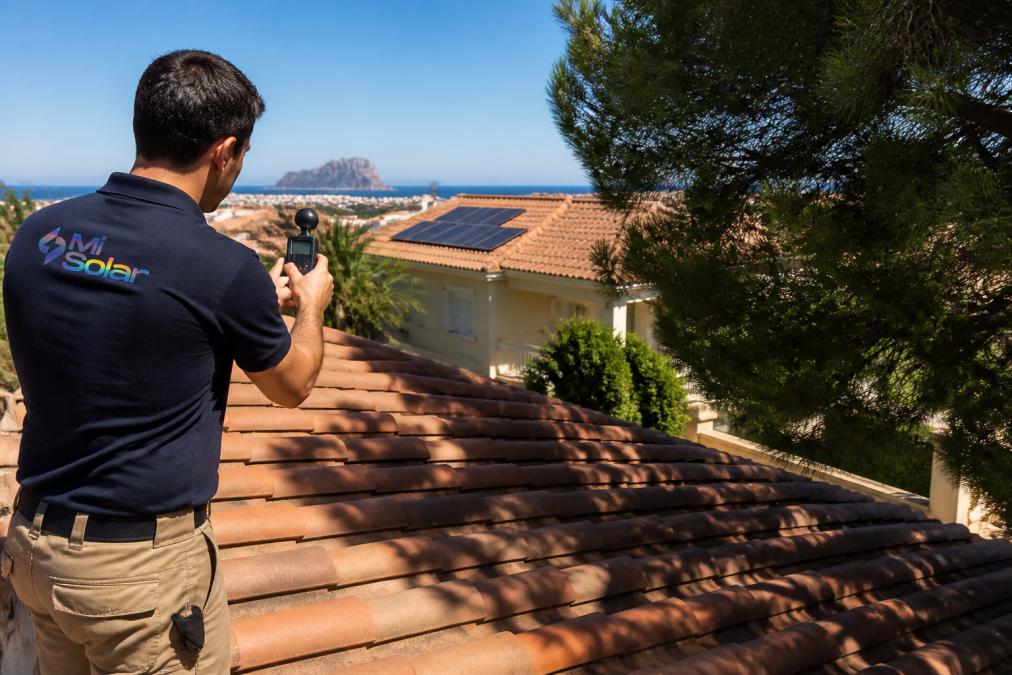
Management options include:
- Module-level power electronics. Optimisers or microinverters isolate each panel so shaded units do not drag down the rest of the string.
- String layout redesign. Splitting arrays across multiple MPPT inputs lets the inverter treat differently shaded sections independently.
- Physical mitigation. Where a tree is the culprit, pruning or repositioning the array can be cheaper than compensating with hardware.
The engineering stage is also where structural checks, cable routing, and inverter placement get decided. Skipping it is how homeowners end up with a system that looks fine on paper and underdelivers in February. Proper planning also accounts for future energy demands, ensuring that your electrical infrastructure can support the integration of home EV charging costs without requiring expensive retrofits later.
Which Solar Systems Suit Different Homes
System choice should follow the household, not the other way round. A permanent residence with a pool, air conditioning, and an EV will justify a very different specification from a holiday home occupied a few months a year.
| System Type | Best For | Key Consideration |
|---|---|---|
| Grid-tied, no battery | Homes with high daytime consumption | Lowest upfront outlay, fastest payback |
| Hybrid with battery storage | Villas wanting evening cover and grid independence | Higher cost, better resilience and self-consumption |
| Solar plus pool heating | Properties with a pool in regular use | Cuts the single largest summer load |
| Solar plus EV charging | Households running an electric vehicle | Shifts transport fuel costs onto the roof |
For holiday homes, the calculus differs. A system still generates and can export while you are away, and it protects the property against future rate rises, but self-consumption is naturally lower. Many owners in this position pair solar with battery storage and monitoring so the system works year-round without supervision.
Government Incentives and Grants for Solar
Incentives vary by municipality and by region, and they change with each budget cycle. Common forms of support include reductions on the IBI property tax, rebates on installation, and allowances for battery storage. Because eligibility rules and application windows differ from one council to the next, the only reliable approach is to confirm current terms with your local authority or a provider that handles the paperwork on your behalf.
Reliable Installers That Handle Engineering and Design
Reliable installers are the ones who carry the engineering and design work in-house rather than subcontracting it, and who can demonstrate shading analysis before you sign anything. Ask to see the shading study, the production estimate, and who is legally responsible for permits.
On that question, there are several established providers operating across the Costa Blanca North. Each handles installations, and each will quote you a system.
What separates providers is rarely the panel. It is the design discipline behind it. At MiSolar, engineering, permitting, procurement, and on-site works are managed in-house, which means the shading analysis that informs your design is the same team's responsibility through to commissioning. We have completed more than 300 installations across the region, and our local knowledge of roof types and municipal requirements shapes the design from the first site visit. Alongside Residential Solar Installation and Solar PV Installation Services, we also fit high-efficiency air conditioning and solar pool heating, so the systems that drive your daytime consumption can be designed around the array from the outset.
Conclusion
The question of whether solar is worth it in Spain usually turns on execution rather than potential. The sun is there, the rates are high, and the payback maths works, provided the system is designed around your actual roof and your actual consumption.
That is where MiSolar comes in. We handle engineering, permitting, procurement, and installation in-house, design around shading rather than ignoring it, and offer financing plans alongside post-commissioning monitoring and performance checks. Get a quote from MiSolar and find out what your roof can actually produce.
Frequently Asked Questions
How long does it take for solar panels to pay for themselves?
The solar panel payback period depends on your system size, electricity usage and how much power you consume directly. Most homeowners who run appliances during daylight hours reach break-even in around 2 to 5 years. Systems sized for higher self-consumption pay back faster than oversized arrays that export most of their output. A properly engineered design matched to your actual consumption profile is the single biggest factor in shortening that period.
Are there government grants or tax incentives for solar installations?
Yes. Spanish homeowners can access European Next Generation EU funding channelled through regional programmes, plus local IBI and ICIO tax rebates offered by many municipalities. The exact amount and availability vary by region and by year, so it is worth checking current terms before you commit. A full-service installer will usually handle the paperwork for these incentives as part of the permitting process, which saves you chasing multiple offices yourself.
Do solar panels work efficiently during the winter months?
Output drops in winter because days are shorter and the sun sits lower, but panels still generate useful power. Cooler temperatures actually improve panel efficiency, so a clear winter day can produce well. The bigger variable is shading, since a low winter sun casts longer shadows from trees and neighbouring buildings. A shading analysis during the design stage shows exactly how much output you lose in the worst month and whether optimisers or micro-inverters are needed.
Are there reliable solar installers that handle the entire engineering and design process to ensure I avoid shading issues?
Several firms across the region manage the full process in-house, including MiSolar. What separates them is whether engineering, permitting and shading analysis are done by their own team or subcontracted. Ask for a shading study with modelled production figures, confirmation of who holds the licence, and details of the aftercare and monitoring support included. That tells you more than the headline quote ever will.