 listicle
7 Ways to Reduce Electricity Bills in Spain
Table of Contents
- 1. Check Your Contracted Power and Switch Tariff
- 2. Shift Heavy Appliance Use to Off-Peak Hours
- 3. How to Read an Electricity Bill in Spain and Spot Waste
- 4. Cut Standby Load and Upgrade to LED Lighting
- 5. Tune Your Air Conditioning and Hot Water Habits
- 6. Solar Panels for Villas in Spain: Cut the Bill at Source
- 7. Energy-Saving Tips for Holiday Homes and Empty Properties
- Which Changes Should You Make First?
- Frequently Asked Questions
Last Updated: 18 October 2026
1. Check Your Contracted Power and Switch Tariff
Most households in Spain pay for more contracted power than they actually use. The potencia contratada is the maximum kilowatt capacity your installation can draw at once, and it sets a fixed daily charge that appears on every bill regardless of consumption.
Start by checking your boletín eléctrico or the contract summary in your supplier's app. Look at your peak demand across a full year, not just summer. If your air conditioning runs two splits and a hob, you need headroom. If you live alone in a flat with gas cooking, you almost certainly do not.
Then look at the tariff structure. Spanish regulated supply uses time-of-use pricing across three periods (punta, llano and valle), and the peak rate is where the money goes. A tariff with a cheaper valley period rewards households that can shift load.
We manage this review as part of every solar design at MiSolar, because the right contracted power changes once panels are on the roof. Get the contract wrong and you cap the benefit of your own generation.
2. Shift Heavy Appliance Use to Off-Peak Hours
Timing is the second lever, and it costs nothing to pull. Washing machines, dishwashers, tumble dryers, immersion heaters and EV charging can all move to the valley period without any change to how you live, as long as you set a delay timer.
The practical routine looks like this:
- Run the washing machine and dishwasher on a delayed start, timed to finish before you wake
- Charge an electric car overnight rather than on return from a trip
- Heat water in the early hours if you have a storage cylinder rather than instantaneous heating
- Run the pool pump on a timer during the cheapest window
- Batch cooking and oven use into the valley period at weekends
Households with a rooftop system get a second, better window: the middle of the day, when the panels are producing. uSwitch Energy's Spain electricity guides make the same point, recommending that appliances run during solar hours where a system is installed. Using your own generation beats buying cheap grid power, because the self-consumed kilowatt-hour is one you never purchase at all.
The one habit to break is the evening peak. Between roughly early evening and bedtime, rates are at their highest and a villa's consumption spikes as cooking, hot water, cooling and entertainment all overlap.
3. How to Read an Electricity Bill in Spain and Spot Waste
An electricity bill in Spain is a fixed-charge document plus a consumption document, and confusing the two is why people misjudge where their money goes. Reading it properly takes about ten minutes.
Work through it in this order:
| Bill section | What it tells you | What to check |
|---|---|---|
| Potencia contratada | Your fixed capacity charge | Is the kW rating higher than your peak demand needs? |
| Energy consumed by period | kWh used in punta, llano and valle | Which period dominates your usage? |
| Taxes and charges | Electricity tax and VAT | Confirm the rate applied matches your contract |
| Meter rental | Monthly equipment charge | Is it a rented or owned meter? |
| Other concepts | Adjustments or services | Anything unexplained should be queried with the supplier |
The consumption split is the diagnostic. If most of your kilowatt-hours sit in the peak period, your problem is timing, not volume, and section 2 fixes it. If your valley usage is already high but the bill is still large, the problem is volume or a load you have not identified.
4. Cut Standby Load and Upgrade to LED Lighting
Standby consumption is small per device and stubbornly large in total. A villa with two televisions, a router, a games console, a microwave clock, a sound system and three phone chargers is drawing power around the clock, every day of the year.
Energy Nordic's guide to summer electricity savings recommends unplugging devices that are not in use, and that advice holds year-round. The practical version is a switched extension strip for the television corner and the home office, turned off at the wall each night.
Lighting is the other easy win. Replacing older bulbs with LED equivalents cuts the wattage drawn for the same brightness, and the payback is quick because the bulbs are inexpensive and last for years.
- Swap halogen downlights for LED equivalents of the same fitting size
- Put exterior and garden lighting on a timer or a dusk sensor
- Use motion sensors in corridors and stairwells rather than leaving lights on
- Replace the pool's underwater lighting with LED if it is still halogen
None of this requires an electrician for the most part, and none of it changes how the house feels to live in.
5. Tune Your Air Conditioning and Hot Water Habits
Cooling and hot water are the two largest controllable loads in most properties here, and both respond to small adjustments rather than dramatic ones. Endesa's household energy-saving guidance points to appliance efficiency and everyday habits as the practical levers, and air conditioning sits at the top of that list.
Set cooling to a temperature you can actually live with rather than the lowest number the remote allows. Each degree lower costs meaningfully more to run. Clean the filters monthly during the cooling season, because a clogged filter forces the unit to work harder for the same output.
Hot water follows the same logic. A cylinder set hotter than you need wastes energy standing at temperature. Lower the setpoint to a comfortable level, insulate the cylinder and the first metre of pipe, and fix dripping taps promptly.
If the air conditioning itself is old and struggling, replacing it with a high-efficiency unit is worth pricing alongside the behavioural fixes. We install high-efficiency air conditioning across the region and can advise on whether a replacement pays back faster than repair.
6. Solar Panels for Villas in Spain: Cut the Bill at Source
Every measure above reduces demand. Solar panels for villas in Spain attack the bill from the other direction, by generating the electricity on your own roof and shrinking what you buy from the grid.
A well-sized system changes the arithmetic of the whole bill.
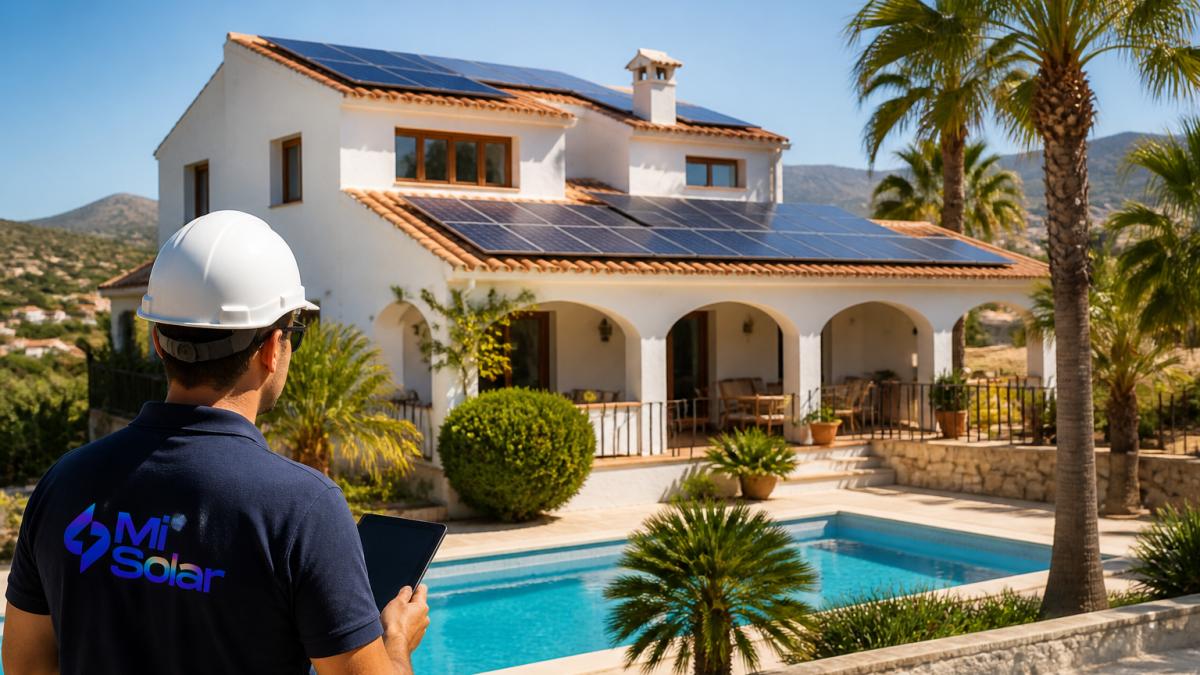
The engineering matters more than the panel brand. Roof type, shading from neighbouring trees, orientation and the shape of your consumption curve all determine what a system can realistically deliver.
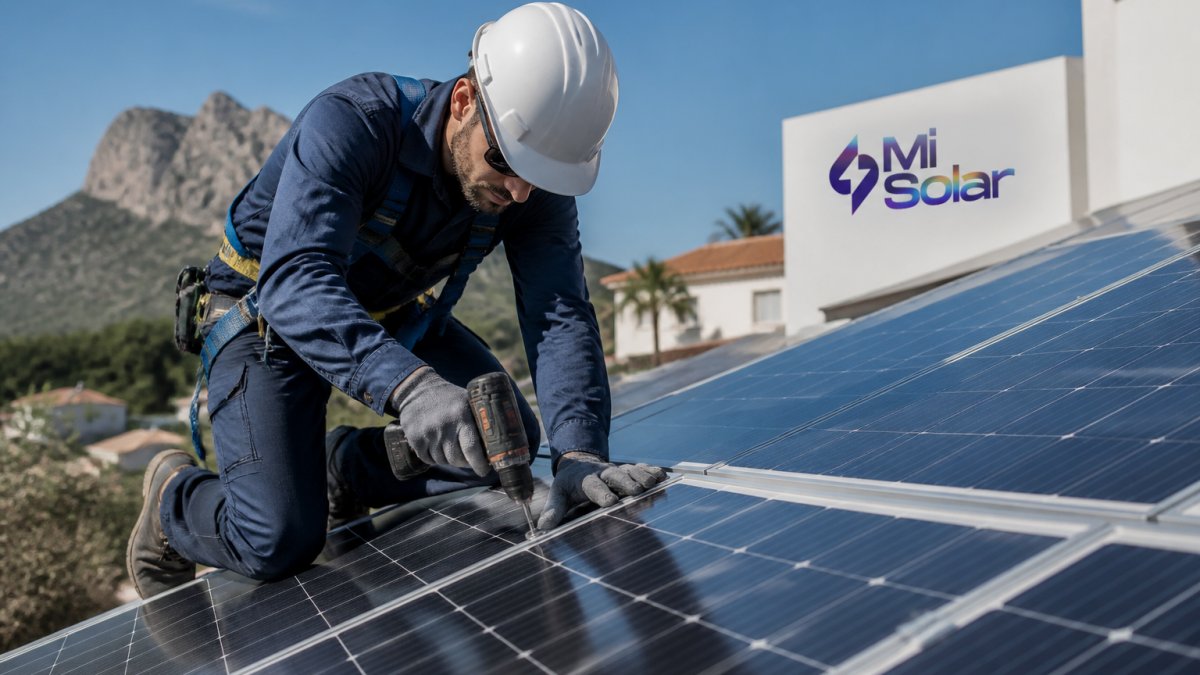
MiSolar has completed more than 300 installations, and we handle the engineering, permitting, procurement and on-site works in-house.
7. Energy-Saving Tips for Holiday Homes and Empty Properties
An empty property still costs money, and often more than owners expect. Standing charges, the pool pump, the fridge, the alarm and the hot water cylinder all keep running while nobody is there.
Energy-saving tips for holiday homes start with matching the contract to the occupancy pattern. A property used for a few months a year rarely needs the same contracted power as a permanent residence, and the fixed charge is where the waste sits. Review the potencia against real occupancy rather than keeping the previous owner's settings.
Then deal with the loads that run while you are away:
- Put the pool pump on a timer sized to the filtration the pool actually needs
- Turn off or unplug the second fridge and any entertainment equipment between visits
- Set the hot water cylinder to a low frost-protection level, not full temperature
- Use timers or smart plugs so lighting and cooling run only when the house is occupied
- Check the meter reading remotely, or have someone read it, to catch a fault before it runs for months
A rooftop system suits this pattern well. Generation offsets the standing daytime loads, and any surplus can be exported rather than wasted.
Which Changes Should You Make First?
Sequence matters more than effort. Here is the order we would follow, cheapest and fastest first:
- This week, free: read the bill properly, note your contracted power and your period split
- This month, near-free: set delay timers on the washing machine, dishwasher and pool pump
- This month, low cost: switch off standby loads at the wall and replace the most-used bulbs with LED
- This season, low cost: tune the air conditioning setpoint, clean the filters, lower the cylinder temperature
- This season, contract work: adjust contracted power to match real demand and move to a tariff that fits your usage pattern
- This year, capital work: size a solar system, with battery and EV charging if the usage justifies it
Steps one to four cost little and deliver immediately. Step five is a phone call. Step six is the one that changes the bill permanently, and it is worth doing once the demand side is already tidy, because a smaller, better-designed system costs less than one sized to cover waste.
The bills that hurt most are rarely the ones with the highest consumption. They are the ones where nobody has checked the contract, the timing or the standby load in years. If you want to take the last step and cut the bill at source, MiSolar designs and installs complete solar systems across the Costa Blanca North, handling engineering, permits and installation in-house, with financing plans available and monitoring support after commissioning. Get a quote.
Frequently Asked Questions
How can I reduce my electricity bill in Spain?
Start with your contract: check the contracted potencia and whether your tariff suits your usage pattern, then shift dishwashers, washing machines and water heating to off-peak hours. Cut standby load by unplugging unused devices, switch to LED bulbs, and set air conditioning a couple of degrees less extreme. If you own a villa with a suitable roof, solar panels reduce the bill at source and can bring it close to zero during daylight hours.
Is it cheaper to use electricity at certain times in Spain?
Yes. Time-of-use tariffs charge less during off-peak windows, which typically fall overnight and at weekends, with peak rates in the evening. Running the washing machine, dishwasher and water heater inside the cheaper window lowers the bill without changing how much you use. If you add solar panels, the middle of the day becomes your cheapest period because you are consuming your own generation rather than buying from the grid.
Can solar panels reduce electricity bills for a villa?
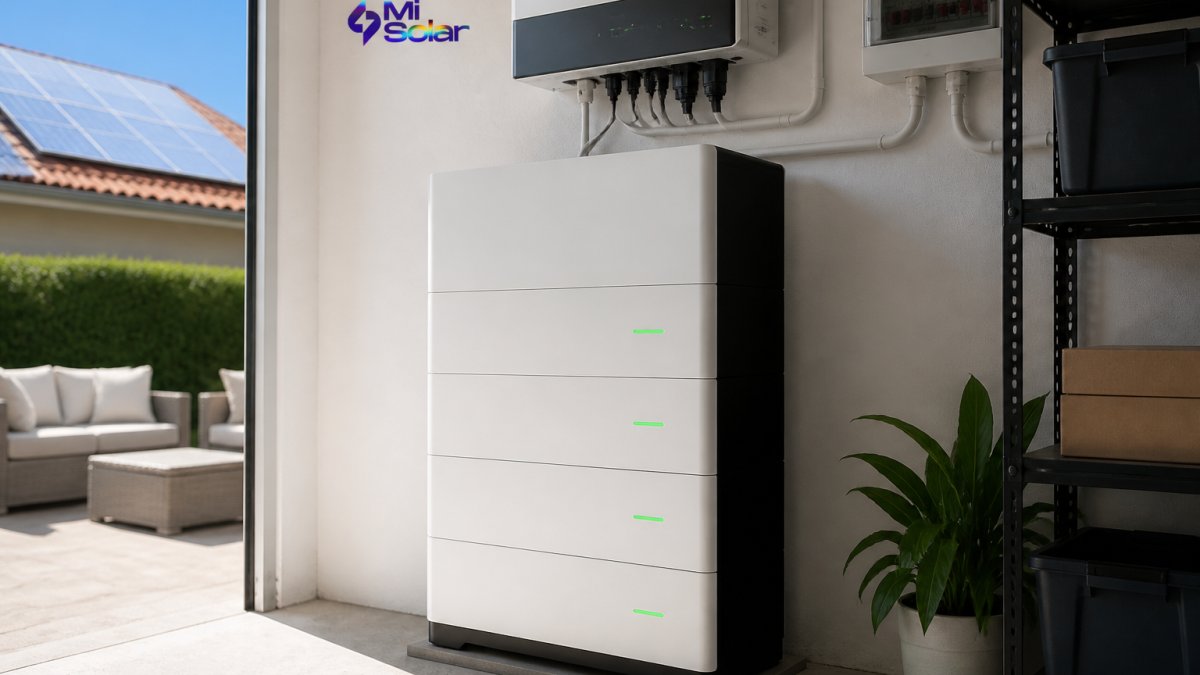
They can. A well-sized system on a villa roof generates power during daylight hours, and every kilowatt-hour you use on site is one you do not buy. Villas with pools, air conditioning and EV charging have high daytime consumption, which suits solar particularly well. Adding battery storage lets you use generation after sunset, and MiSolar designs systems around your actual consumption, roof type and orientation before quoting.
How can I save electricity in a holiday home that is empty for part of the year?
Empty properties still waste power through standby loads, so unplug appliances or switch them off at the socket when you leave. Set the water heater and air conditioning to a low-maintenance mode rather than leaving them running, and consider a timer for the pool pump. Remote monitoring on a solar system lets you check generation and consumption from anywhere, which is useful when the property is unoccupied for months.
Are batteries worth adding to a home solar system?
A battery makes sense if you use a lot of electricity in the evening, when solar generation has stopped. It stores surplus daytime production for later, which raises the share of your own solar power you actually consume. If most of your usage is during the day, for example with air conditioning and a pool pump, a battery is less essential. MiSolar can model both options against your consumption pattern before you commit.