
 how-to
How to Choose Solar Installers: 2026 Buyer's Checklist
Table of Contents
- What Separates a Good Solar Installer From a Bad One
- Solar Installer Certifications and Credentials to Check
- How the Solar Panel Permitting Process Works With a Professional Installer
- Solar Panel Warranty Coverage: What to Read Before You Sign
- Questions to Ask Potential Installers Before You Commit
- Common Mistakes Homeowners Make When Choosing Solar Installers
- Conclusion
- Frequently Asked Questions
Last Updated: September 22, 2026
What Separates a Good Solar Installer From a Bad One
Choosing the right solar installers is the single decision that determines whether your system saves you money for 25 years or becomes a headache you regret. The difference rarely comes down to price. It comes down to who actually does the work and whether they understand your roof, your street, and your local council.
This guide from MiSolar breaks down the checks that matter before you sign anything. Homeowners who ask the right questions upfront avoid almost every problem later.
So what actually separates the good from the bad?
In-house teams versus subcontracted labour
A good installer employs their own engineers and fitters. A bad one sells you a system, then hands the job to whoever is available that week.
The difference shows up when something goes wrong. With an in-house team, one company is accountable for the design, the wiring, and the paperwork. With subcontractors, responsibility gets passed around.
Ask directly: "Who will be on my roof, and are they employed by you?" A vague answer tells you plenty.
Local knowledge that changes your system design
Roof type matters enormously. Terracotta tiles, flat roofs, and pitched Mediterranean designs all need different mounting systems. A team that works in your area every week knows which brackets hold up to coastal humidity and which ones rust within two summers.
Local knowledge also covers shading. A neighbour's tree that blocks your roof every afternoon in winter changes the whole design. An installer who knows the area will spot that before quoting.
Solar Installer Certifications and Credentials to Check
Solar installer certifications are the quickest way to filter out cowboys. In Spain, any company carrying out electrical installation work must be registered as an instalador autorizado with the relevant regional authority. Without that registration, they cannot legally sign off your installation or connect it to the grid.
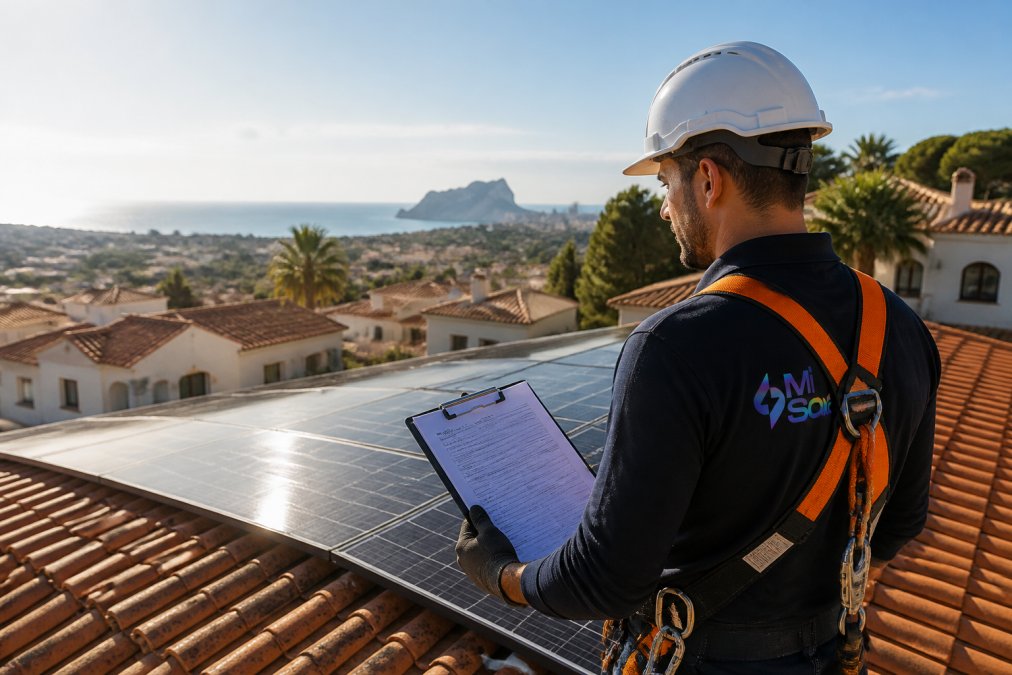
Electrical contractor registration and installer credentials
Ask for the registration number and check it yourself. It takes five minutes and rules out a large share of unreliable operators.
Beyond registration, look for:
- Proof of public liability insurance
- Manufacturer certifications for the panels and inverters they fit
- Membership of a recognised industry association
- Named engineers, not just a sales team
A legitimate installer will hand these over without hesitation. Reluctance here is your first red flag.
The official guide to authorised electrical installers from the regional industry ministry explains what registration involves and why it protects you.
How the Solar Panel Permitting Process Works With a Professional Installer
The solar panel permitting process in Spain involves two separate tracks: municipal planning approval and grid connection approval. Both take time, and both require documentation that only a registered installer can produce.
Here is how the stages typically run:
| Stage | Who Handles It | Typical Duration |
|---|---|---|
| Municipal building permit | Installer submits | 4-8 weeks |
| Grid connection application | Installer submits | 4-12 weeks |
| Technical documentation | Installer prepares | 1-2 weeks |
| Installation works | Installer completes | 1-3 days |
| Final sign-off and registration | Installer manages | 2-4 weeks |
Timelines vary by council. Some move quickly, others do not. A full-service installer tracks every stage and chases the paperwork so you do not have to.
Questions to ask about permits before you sign
- Will you handle the municipal permit application in full?
- Who pays the permit fees if the council requests changes?
- Do you manage the grid connection, or do I need to contact the utility myself?
- What happens if the council rejects the initial application?
If an installer says permits are "your responsibility", walk away. That answer usually means they have never done it properly.
Solar Panel Warranty Coverage: What to Read Before You Sign
Solar panel warranty coverage comes in three layers, and most homeowners only check the first one. The panel product warranty, the inverter warranty, and the workmanship warranty are separate documents with separate terms.
Workmanship warranty is the one that covers installation faults: loose mounts, wiring problems, roof leaks. This is the warranty you will most likely need, and it is the one bad installers quietly leave out.
Read for these details:
- How long each warranty runs
- What voids it (moving the system, unauthorised repairs)
- Whether it transfers if you sell the property
- Who honours it if the installer closes
That last point matters. A 25-year panel warranty is worthless if the company that fitted it no longer exists.
Performance guarantees and what happens if output falls short
A performance guarantee states how much energy your system should produce. If output falls short, the guarantee should specify a remedy: a repair, a top-up payment, or a refund.
Ask for the guaranteed annual output in writing, in kilowatt-hours. Then ask what happens if the system misses it. An installer who cannot answer clearly has not thought about it.
Questions to Ask Potential Installers Before You Commit
Use this checklist when you speak to each company. Tick every box before you sign.
- Are you a registered instalador autorizado? What is your number?
- Will your own employees carry out the installation?
- Can I see three recent installations in my area?
- Do you handle the municipal permit and grid connection in full?
- What is the guaranteed annual output in kWh?
- What does the workmanship warranty cover, and for how long?
- What happens if output falls short of the guarantee?
- How will you handle afternoon shading from neighbouring trees?
- What financing options do you offer, and on what terms?
- Who do I call in year five if something breaks?
That final question separates the serious operators from the rest. MiSolar provides post-commissioning support, including monitoring setup and performance checks, so there is a named point of contact long after the scaffolding comes down.
Common Mistakes Homeowners Make When Choosing Solar Installers
The biggest mistake is treating solar as a commodity. It is not. Two quotes for the "same" system can differ hugely in panel quality, mounting hardware, and who does the work.
Other errors we see regularly:
- Choosing on price alone. A quote that comes in much lower usually cuts corners somewhere: thinner mounts, cheaper inverters, or subcontractors.
- Skipping the roof survey. Shading and tile condition change the design. No survey, no reliable quote.
- Ignoring the workmanship warranty. Panels rarely fail. Installations do.
- Not asking about permits. If the installer will not manage them, you are taking on weeks of paperwork.
- Forgetting about the future. If you plan to add battery storage or an EV charger later, say so now. The system design should leave room for it.
One more thing most guides miss: ask how the installer handles a property that sits empty for part of the year. Holiday homes need a different setup, and the right design still pays off through reduced standing charges and added property value.
Conclusion
Choosing solar installers is a test of patience, not price. The right company holds the proper registration, employs its own team, manages every permit, and puts its guarantees in writing.
MiSolar handles the full process in-house, from engineering and permitting to procurement and on-site works. We design each system around your roof, your consumption, and your plans for the future, whether that includes battery storage, an EV charger, or a solar pool heater. With tailored financing plans and post-commissioning monitoring, the goal is simple: cut your bills, raise your property value, and enjoy long-term energy security.
Get a quote from MiSolar and find out what your roof can actually do.
Frequently Asked Questions
What certifications should a professional solar installer hold?
In Spain, installers must be registered as authorised electrical contractors with the relevant regional industry authority. Look for credentials in low-voltage electrical installation and, for battery systems, specific storage certification. Membership of a recognised industry association is a useful signal. Ask to see documentation before signing and check that the company holds current public liability insurance. A credible solar installer will provide these without hesitation.
How do I verify a solar installer's reputation and past projects?
Ask for addresses of recent installations in your area and, where owners agree, visit one to see the workmanship and hear about the after-sales experience. Check online reviews across multiple platforms, not just the installer's own website. Ask how many systems they have commissioned locally and whether they handle maintenance themselves. An installer with a strong track record should be able to demonstrate their work.
How does the solar panel permitting process work with a professional installer?
A full-service installer handles the municipal building permit, the grid connection application with your distribution company, and any regional authorisation required. Timelines vary by municipality, so ask for a realistic estimate in writing. The installer should also manage the legalisation of the electrical installation and register the system for any applicable self-consumption scheme. If a company asks you to chase permits yourself, that is a warning sign.
What should I check in solar panel warranty coverage before signing?
Separate the panel manufacturer warranty from the installer's workmanship warranty. Panels typically carry a product warranty and a separate performance warranty, while the inverter and battery have their own terms. Confirm who handles a claim: the installer or the manufacturer. Ask whether monitoring and annual performance checks are included, and get the response times in writing. A clear warranty document protects you long after the scaffolding comes down.