 How-to
7 Solar Battery Backup Steps for Vacation Rentals
Last Updated: November 19, 2026
Quick Summary
To optimize solar battery backup for vacation rentals, run an energy usage audit, size the battery to the evening peak rather than the annual average, and set self-consumption mode with a locked minimum reserve. Prioritize critical circuits, monitor remotely between stays, and shift settings with the Jávea seasons.
- Pull twelve months of bills to see the summer and winter split before sizing anything.
- Set a minimum reserve of 20% to 30% of usable capacity to protect backup power.
- Critical circuits such as fridge, wifi, lighting and one AC zone stay live during outages.
- Keep the guest energy guide to one page covering appliances, blackouts and who to call.
- In winter, raise the reserve and allow grid charging as a fallback.
Table of Contents
- Why Solar Battery Backup Pays Off for Vacation Rentals
- Step 1: Run an Energy Usage Audit on Your Rental
- Step 2: Solar Battery Sizing for Holiday Homes
- Step 3: Set Up Solar Battery Settings for Vacation Rentals
- Step 4: Prioritize Critical Circuits and Set a Minimum Reserve
- Step 5: Remote Monitoring for Solar Batteries Between Stays
- Step 6: Write a Guest Energy Guide for Solar-Powered Rentals
- Step 7: Adjust for Jávea Seasons and Spanish Regulations
- Frequently Asked Questions
Why Solar Battery Backup Pays Off for Vacation Rentals
Solar battery backup is a storage system that captures excess solar generation during the day and releases it at night or during a power outage. For a vacation rental in Jávea, that stored energy does two jobs: it cuts the grid electricity a guest consumes after dark, and it keeps the lights, wifi and fridge running when the supply fails.
Guests arrive in the evening, run air conditioning until midnight, and leave the following morning. Without a battery, almost all of that consumption is bought from the grid.
The payoff comes from three places:
- Night use shifts from paid grid electricity to free stored energy
- Guest comfort holds through a summer blackout, which protects rental reviews
- Property value rises with a documented, working solar storage system
For the wider investment case on a holiday home, our guide to solar investment for holiday homes sets out the numbers. Below, we walk through the seven steps we use to optimize solar battery backup for vacation rentals, from the first audit to the seasonal settings.
Step 1: Run an Energy Usage Audit on Your Rental
Start by measuring what the property actually consumes, not what you assume it does. A rental has a different load profile from a family home: long absences, then sudden heavy demand.
Pull the last twelve months of bills and note the split between summer and winter. Then look at what runs while guests are in residence:
- Air conditioning, usually the largest single load
- Pool pump, if there is one
- Hot water and kitchen appliances
- EV charging, if you offer it
Real-time energy usage tracking makes this far easier than reading old bills. Our article on real time energy usage tracking at home explains how the data helps you spot the loads that matter.
Watch out: hosts often size a system on the annual average. A rental's demand is not average. It spikes hard in July and August, and that peak is what the battery must cover.
Step 2: Solar Battery Sizing for Holiday Homes
Solar battery sizing for holiday homes should match usable storage capacity, measured in kilowatt-hours, to the evening and overnight load the guests actually create, not to the annual average. Oversizing wastes money; undersizing leaves guests on grid power by 11pm.
A common mistake on the Costa Blanca North is sizing from a family-home rule of thumb. A rental in Jávea does not behave like a family home. It sits empty for days, then a group of six arrives, runs air conditioning in three bedrooms until after midnight, heats water for showers, runs the pool pump on its timer, and does two loads of laundry before checkout. The battery has to cover that simultaneous evening peak, not a smoothed daily figure.
Build the sizing from four rental-specific loads:
- Air conditioning. In July and August, cooling is usually the dominant evening load in a Jávea villa. Note how many bedrooms and living zones run at once, and whether guests leave AC on overnight.
- Pool pump. If the pump runs on a timer, schedule it for daylight hours so it draws from solar generation rather than the battery. If it must run in the evening, count it in the overnight load.
- Water heating and kitchen. Showers after a beach day and evening cooking cluster demand into a short window. A heat-pump or timer-controlled cylinder reduces the battery draw.
- Laundry and EV charging. These are the loads most likely to collide with the evening peak. Move them to daytime wherever the property allows.
A practical method is to take the measured overnight consumption from Step 1, add the simultaneous evening peak of the cooling and hot-water loads, then apply a margin for cloudy days and for the battery's usable capacity rather than its headline figure. A villa with air conditioning usually needs more usable storage than a small apartment, and a villa with a pool and EV charger more again, but the exact figure should come from the audit, not from a generic table.
| Rental type | Typical evening/overnight load pattern | Battery approach |
|---|---|---|
| Small apartment, 2 guests | Lights, wifi, fridge, occasional AC | Small battery, reserve held for outages |
| Villa with air conditioning | Multiple AC zones running late into the night | Larger battery, cooling circuits prioritised |
| Villa with pool and EV charger | Pool pump, EV charging, AC and laundry overlapping | Large battery plus a daytime charging plan for pool and EV |
Step 3: Set Up Solar Battery Settings for Vacation Rentals
Solar battery settings for vacation rentals should prioritise self-consumption in summer and hold a reserve for outages year-round. The settings are where most systems underperform, because a default profile is built for a family home, not a rental.
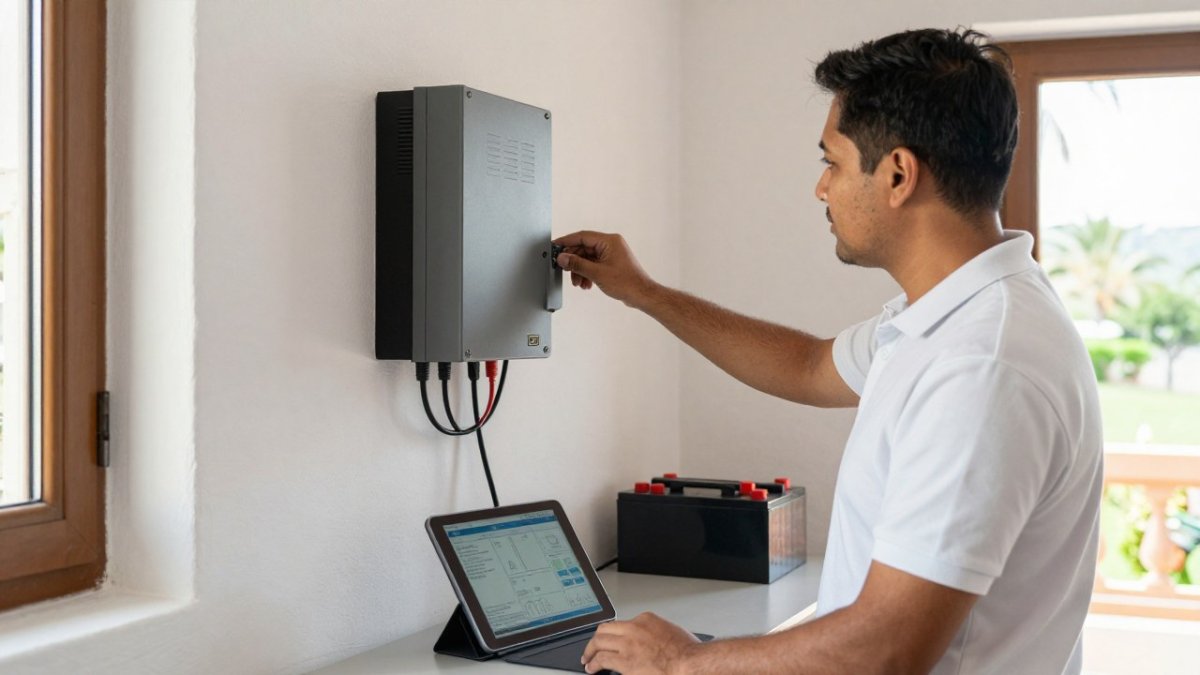
The settings we adjust first:
- Self-consumption mode so stored energy covers the evening, not the grid
- Grid charging off in summer, on only as a winter backup
- Discharge window set to the hours guests actually use power
- Minimum reserve locked so a blackout never finds an empty battery
If you want the hardware and setup handled properly, our solar battery storage and backup power service covers installation and configuration.
Step 4: Prioritize Critical Circuits and Set a Minimum Reserve
Load prioritization decides which circuits stay live when the grid drops. A battery has a power output limit, so it cannot run the whole villa at once during an outage.
We split the property into two groups. Critical circuits run from the battery during a blackout: fridge, wifi, lighting, and one air conditioning zone. Non-critical loads, such as the pool pump and EV charger, switch off automatically.
Then set a minimum reserve, usually between 20% and 30% of usable capacity. That floor protects battery lifespan and guarantees backup power is there when a guest needs it.
Step 5: Remote Monitoring for Solar Batteries Between Stays
Remote monitoring for solar batteries lets a host check system health, generation and battery charge from anywhere, without visiting the property. For an owner who is not on site, this is the difference between a quiet system and a surprise bill.
Set up alerts for three things:
- Battery state of charge dropping below the reserve
- A fault or communication loss
- Unusual consumption between bookings
Our guide to managing solar energy remotely goes deeper on the tools and routines that work between guest stays.
Step 6: Write a Guest Energy Guide for Solar-Powered Rentals
A guest energy guide is a short, plain-language document that tells guests how the solar system works and what they can do to keep it performing. Guests are not the problem. Unclear instructions are.
Keep it to one page and cover:
- What the battery does and when it takes over
- Which appliances to avoid running all at once
- What to do if the power drops during a blackout
- Who to call, and when
A simple guide protects guest comfort, reduces panicked messages, and keeps rental reviews positive. It also protects the battery from being drained by heavy simultaneous loads.
Step 7: Adjust for Jávea Seasons and Spanish Regulations
Seasonal settings should shift with the Jávea calendar: heavy self-consumption and cooling priority in summer, more grid charging and reserve protection in winter. The town's summer rental demand and long, bright days make battery storage especially effective here, but the same system that performs well in August needs different settings in February, when occupancy is lower, days are shorter, and the shoulder season can bring cloud and rain.
A workable seasonal routine looks like this:
- Summer (roughly June to September). Maximise self-consumption, keep grid charging off, prioritise cooling circuits, and set the discharge window to cover the late-evening AC and hot-water peak. Pool pumping and laundry should run in daylight.
- Shoulder season (spring and autumn). Keep self-consumption as the default, but allow grid charging as a fallback if several cloudy days are forecast. This is when Jávea can see unsettled weather while guests still expect reliable power.
- Winter. Raise the minimum reserve, allow grid charging to protect the battery and guarantee backup, and reduce the discharge window to the hours guests actually use power. Winter occupancy is lower, so the battery has more headroom, use it to protect the reserve rather than to chase every kilowatt-hour.
Spanish and Valencian rules also shape the install. Domestic solar work must follow the REBT electrical standard, and grid connection and self-consumption paperwork go through the regional process. In practice, hosts should expect to deal with three things: the self-consumption arrangement (whether surplus is exported or compensated), the grid-connection approval from the distribution company, and the local building or installation permissions that apply in the municipality. Our guide to the Costa Blanca solar permitting process covers the local steps in detail.
Watch out: hosts sometimes assume the installer handles every permit. Confirm in writing who submits the self-consumption and grid-connection paperwork, who deals with the distribution company, and what happens if the regional process asks for changes, otherwise the regulatory side can stall the install after the hardware is on the wall.
At MiSolar, we handle permitting, engineering and installation in-house, so the regulatory side does not fall to the host., whether that means residential solar installation and solar PV installation services for the main system or EV charger installation to bring guest charging into the daytime solar window.
Frequently Asked Questions
How do I size a solar battery for a vacation rental in Jávea?
Start with an energy usage audit covering a full rental season, not a single week. Add up nightly consumption from air conditioning, the pool pump, fridge and lighting, then match battery capacity in kilowatt-hours to that figure plus a 20-30% buffer for cloudy days and guest overuse. A villa sleeping six with air conditioning typically needs more storage than the same floor area occupied by two people.
What battery reserve should I keep for power cuts at a holiday villa?
Set a minimum reserve of 20-30% so the battery never drains completely, and raise it during summer peak season when outages strain the grid. Keep critical circuits such as fridge, lighting, router and a few sockets on backup power, and leave the pool pump and air conditioning off the backup circuit. This protects guest comfort during a blackout without flattening the battery overnight.
Can guests use a solar battery system without changing its settings?
Yes, if the system is configured correctly. Lock the inverter menu behind an installer code, set automatic seasonal profiles, and label the consumer unit so guests know which circuits are backed up. A one-page guest energy guide covering air conditioning temperatures, pool pump timing and what to do during a power cut keeps behaviour predictable. Remote monitoring for solar batteries lets you spot unusual consumption before a guest reports a problem.
How can a host monitor solar battery performance remotely?
Most modern inverters and batteries report production, consumption and state of charge through a manufacturer app or web portal. Check the dashboard weekly, set alerts for low battery reserve or sudden generation drops, and review data after each guest turnover. If the app flags repeated voltage pushback or a fall in self-consumption, book a system inspection. MiSolar provides post-commissioning support, including monitoring setup and performance checks.