 How-to
How to Design Solar Arrays for Limited Roof Space
Last Updated: November 9, 2026
Quick Summary
Designing solar arrays for limited roof space starts with usable area, not total roof area, since a modern panel needs around 2 square metres for every 400-450 W of capacity. Choose high-efficiency monocrystalline panels to fit more kilowatt peak onto the same tiles, and match the inverter architecture to your roof's orientations and shading.
- A 4 kWp system needs roughly 18-20 square metres of clear roof using standard 400-450 W panels.
- Pay for panel efficiency before extra panels when roof area is the limiting factor.
- On split roofs, use one MPPT per orientation, power optimizers, or micro-inverters to avoid mismatch losses.
- Specify marine-grade or anodised mounting hardware and stainless fixings for coastal Jávea properties.
- Grid-tied self-consumption systems must be registered with the regional authority and notified to the distribution company.
Table of Contents
- How Much Roof Space Do Solar Panels Need?
- Solar Panel Efficiency for Limited Roof Space
- Solar Panel Layout for Multiple Roof Orientations
- Solar Panel Shading and Roof Design
- Designing Solar Arrays for Jávea Roofs: Climate, Aesthetics and Permits
- Get a Tailored Solar Array Design for Your Roof
- Frequently Asked Questions
How Much Roof Space Do Solar Panels Need?
Designing solar arrays for limited roof space starts with one number: usable area, not total roof area. Most homes in Jávea have less usable space than owners assume, because chimneys, vents, and shading eat into the total. As a rule, a modern panel needs around 2 square metres of mounting space for every 400-450 W of capacity, so a 4 kWp system needs roughly 18-20 square metres of clear roof.
Here is the quick reference we use on site:
| System Size | Panels Needed | Usable Roof Area |
|---|---|---|
| 3 kWp | 7-8 panels | 14-16 m² |
| 4 kWp | 9-10 panels | 18-20 m² |
| 5 kWp | 11-13 panels | 22-26 m² |
| 6 kWp | 14-15 panels | 28-30 m² |
These figures assume standard 400-450 W monocrystalline panels. Higher wattage modules shrink the footprint. That matters on a villa with a small south-facing pitch.
Solar Panel Efficiency for Limited Roof Space
Panel efficiency is the single biggest lever when roof space is tight. A 22% efficient module produces more watt-peak per square metre than an 18% one, so you fit more kilowatt peak onto the same tiles. On a constrained roof, pay for efficiency before you pay for extra panels. The premium per panel is usually smaller than the cost of a second array on a less favourable pitch.
Three practical rules:
- Choose high-wattage monocrystalline panels when area is the limit
- Check thermal performance: panels lose output as they heat up, and Alicante summers are brutal
- Match inverter architecture to the layout, not the other way round
A common mistake is buying cheap panels to save money, then discovering you cannot reach the target self-consumption because the roof ran out of room.
Solar Panel Layout for Multiple Roof Orientations
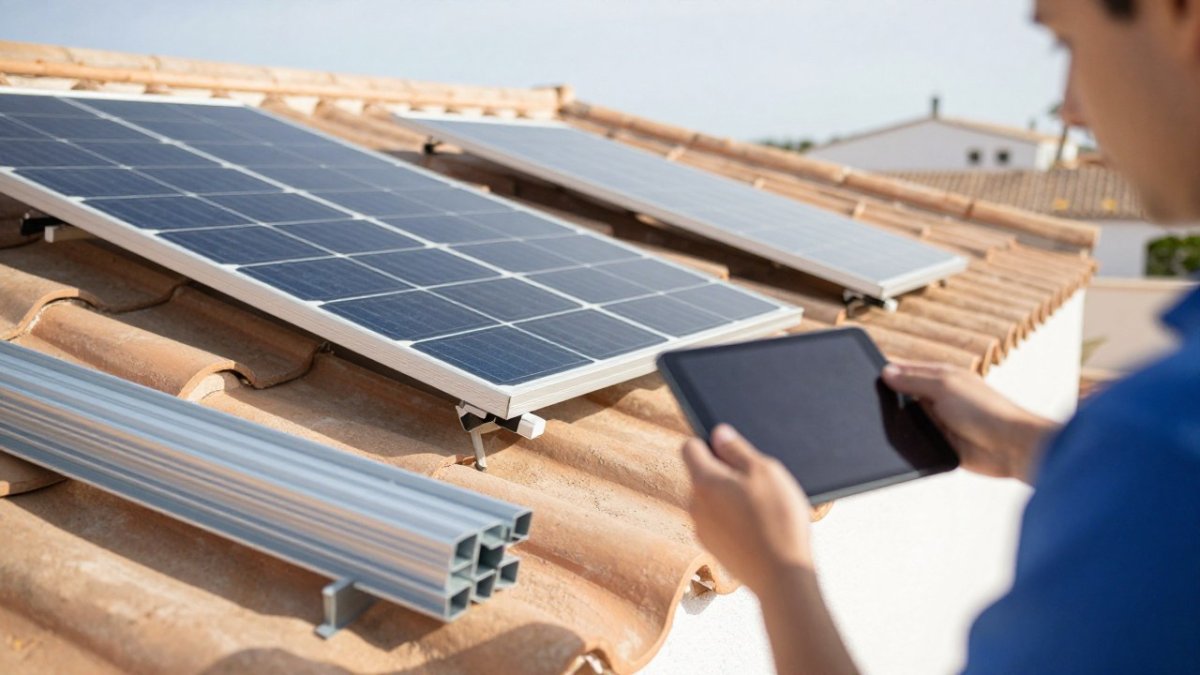
Multiple roof orientations are not a problem. They are a design choice. East-west layouts spread generation across the day, which often suits autoconsumo better than one south-facing array. Azimuth and tilt angle decide how much each pitch contributes.
What most guides miss is that mixing orientations on one string inverter wastes potential. Panels facing different directions produce different currents at the same moment, and a string inverter's MPPT tracks the weakest panel in the string. The practical consequence: on a split roof, either you accept the loss, or you change the architecture.
Three architectures, and when each wins:
- Single string inverter, one MPPT per orientation. Works when each pitch has enough panels to clear the inverter's minimum start-up voltage (commonly around 150-200 V on residential models) and you can run separate strings to separate MPPT inputs. Cheapest per kWp, and the right answer when the roof is split cleanly into two usable pitches.
- String inverter with power optimizers. Each panel's output is conditioned before it reaches the string, so mismatched orientations and partial shade stop dragging the whole array down. Adds cost per panel but keeps a single central inverter, which simplifies maintenance and keeps the inverter indoors.
- Micro-inverters. One unit per panel, full independence, no DC wiring on the roof. Best when the roof is genuinely fragmented, dormers, multiple small pitches, heavy chimney shading, or when you want panel-level monitoring without a central inverter location.
The trade-off is real: more electronics on the roof means more points of failure and a higher upfront cost per kWp, so it only pays when the extra pitch genuinely adds usable area.
Watch out: sizing a string for a mixed-orientation roof using the south pitch's voltage and the east pitch's current will trip the inverter's input limits on a cold, bright morning. String sizing must use the coldest expected cell temperature for voltage and the hottest for current, and Alicante's summer roof temperatures push that second number hard.
For a single clean pitch, a string inverter is cheaper and just as good. If your roof is flat or awkward, our guide to solar panel placement rules for flat roofs covers the spacing and tilt details.
Solar Panel Shading and Roof Design
Shading is the silent killer of solar arrays. A small chimney shadow at 4pm can cut a whole string's output if the panels are wired together without optimizers.
Roof design matters as much as shade. Tiled roofs need different mounting hardware from corrugated or flat roofs, and roof load capacity must be checked. If afternoon tree shade worries you, a proper shading analysis tells you exactly what is achievable before you commit.
Designing Solar Arrays for Jávea Roofs: Climate, Aesthetics and Permits
Jávea roofs bring their own rules, and the three that decide whether a design works are climate, aesthetics and Spanish permitting. Most international guides skip all three.
Climate. High summer irradiance means panels perform well but run hot, so ventilation behind the array matters more here than in northern Europe. Leave the mounting gap the rail system specifies rather than packing panels flush to the tile, a hot panel loses output, and Alicante summers push cell temperatures well above the 25 °C test condition. Coastal properties in Jávea and along the Cap de la Nau also face salt air, which attacks unpainted steel and low-grade aluminium. Specify marine-grade or anodised mounting hardware and stainless fixings; the cost difference is small next to replacing corroded rails in ten years.
Aesthetics. Many villas have terracotta tiles and visible pitches, and owners do not want their home looking like a power station. The practical levers are black-on-black panels with black frames, low-profile mounting that keeps the array close to the tile line, and grouping panels into a single rectangle rather than scattering them.
Permits and the Spanish autoconsumo framework. This is where most homeowners lose months. Grid-tied self-consumption systems in Spain are governed by national autoconsumo rules, which set out the main modalities and the arrangement for surplus exported to the grid. Check the current official guidance before committing to a design. On top of that, the installation must be registered with the regional authority and, for grid connection, notified to the distribution company, which issues the connection agreement. Skipping any one of these can leave a working system that cannot legally export.
One Jávea homeowner kept their pool views and still cut their bills, and we documented how we saved a Jávea homeowner €33,000 without ruining their pool views.
Battery storage fits here too. If you are a holiday owner, storage plus autoconsumo lets you use more of what you generate, and it changes the permit conversation because the battery's capacity and location must be declared alongside the PV system.
Get a Tailored Solar Array Design for Your Roof
No two roofs are the same, and a generic quote will not tell you whether your limited space can hit your energy goals. We manage engineering, permits, and installation in-house, so one team owns the whole job. And if you are weighing up what to power with the array, we also handle EV charger installation and solar pool heating, so the system is sized around your real loads rather than just the roof.
You can see the full scope on our residential solar installation services page, or read how a bespoke solar PV system in Costa Blanca North goes from roof to app before you decide.
Limited roof space is not a reason to skip solar. It is a reason to design carefully. MiSolar has completed 300+ installations across the Costa Blanca North, with a 5.0-star rating, and we build every system around the roof you actually have. Get started with MiSolar and turn your constrained roof into a system that cuts your bills to €0 and pays for itself in as little as 2-5 years.
Frequently Asked Questions
How many solar panels can fit on a small roof?
A typical 1.7 m² panel needs roughly 1.8 to 2 m² of usable roof area once mounting gaps and safety margins are included. On a 20 m² usable section you can fit around 10 panels, roughly 4.5 kWp. Tiled Mediterranean roofs often lose 10-15% of that to ridges, chimneys and walkways, so measure usable area rather than total roof size before sizing your solar arrays.
Which solar panels are best when roof space is limited?
Higher-wattage monocrystalline panels make the most of a small footprint. A 450-500 W module produces more kilowatt peak per square metre than older 350 W models, so fewer panels cover the same consumption. Pair them with micro-inverters or power optimizers to limit losses from shading and mixed orientations, which matters most on compact or split roofs.
Can solar panels be installed on different roof sections?
Yes. Solar panel layout for multiple roof orientations works well when each section uses its own string or micro-inverters, so east and west pitches do not drag each other down. Azimuth and tilt angle differ per section, and a designer will model production for each face before deciding how many panels go where.
How does shading affect a solar array on a small roof?
Shade on even one panel in a string can cut output across the whole string. On a limited roof every panel counts, so a shade analysis should map the shade zone from trees, chimneys and neighbouring buildings across the day and year. Micro-inverters or optimizers reduce the impact, and moving the array to a sunnier section often beats adding panels in shade.