 How-to
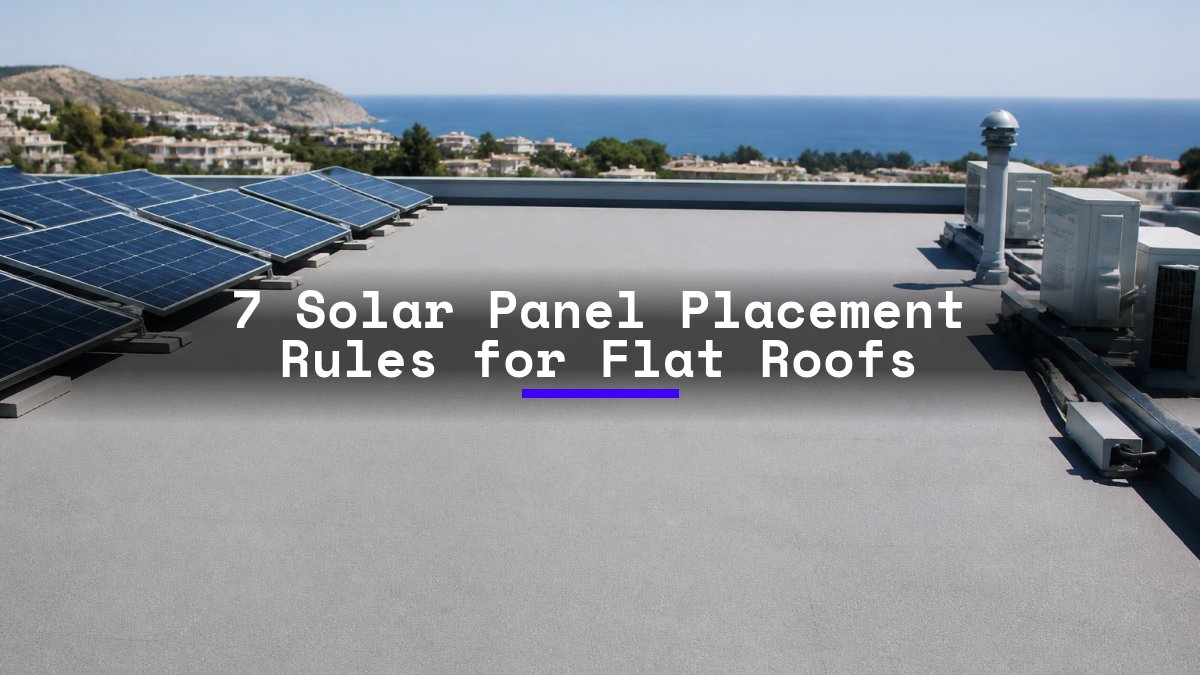
7 Solar Panel Placement Rules for Flat Roofs
Last Updated: November 1, 2026
Quick Summary
A flat roof solar panel layout follows seven rules: survey shading and roof condition first, set a tilt of 5-15 degrees for maximum panels or 15-30 degrees for year-round balance, space rows by winter sun angle, use a ballasted mounting system, and design for wind load with lower tilt, more ballast and edge setbacks.
- Shade is the biggest reason a flat roof underperforms, and a shaded panel drags down the whole string.
- A 5-15 degree tilt fits maximum panels per square metre; 15-30 degrees gives a better year-round balance.
- Row spacing grows with tilt angle and is set by the winter sun angle, never the summer angle.
- A ballasted mounting system holds the array with weight instead of roof penetrations, avoiding future leaks.
- Lower tilt, more ballast and edge setbacks reduce wind uplift on exposed coastal roofs.
Table of Contents
- Start With a Shading Survey and Roof Check
- Set the Right Flat Roof Solar Panel Tilt Angle
- Work Out Flat Roof Solar Panel Spacing Between Rows
- Choose a Ballasted Solar Panel Mounting System
- How Flat Roof Solar Panel Wind Load Changes the Layout
- Book a Flat Roof Solar Survey With MiSolar
- Frequently Asked Questions
Start With a Shading Survey and Roof Check
A solar panel placement guide for flat roofs starts with one job: find out what actually hits your roof. Shade is the biggest reason a flat roof underperforms, and in Jávea the afternoon sun drops behind neighbouring trees and buildings fast.
Here is what a proper survey covers:
- Sun path across the year, not just a summer snapshot
- Obstructions: chimneys, parapets, satellite dishes, water tanks
- Roof condition: waterproofing age, drainage falls, load capacity
- Shading from trees and buildings to the south and west
A flat roof looks open from the street. From panel height, it rarely is.
Watch out: skipping the shading check is the most common mistake we see. A shaded panel drags down the output of the whole string, not just itself.
If you want to understand what the survey involves before you arrange one, read our guide on shading analysis for solar panels.
Set the Right Flat Roof Solar Panel Tilt Angle
The flat roof solar panel tilt angle is a trade-off, not a fixed number. On a pitched roof the angle is decided for you. On a flat roof you choose it, and that choice sets how much power you gain against how much space you lose.
Spain's latitude means a shallow tilt already catches strong sun. Steeper angles help in winter and hurt in summer. Flatter angles pack more rows onto the roof but collect dust and rain less effectively. Optimizing these geometric trade-offs requires careful planning to ensure that structural integrity remains intact while avoiding common flat roof installation mistakes.
A common approach in our region:
- 5-15 degrees for maximum panels per square metre
- 15-30 degrees for a better year-round balance
- Facing south as the default, with east/west splits where the roof shape demands it
The right answer depends on your consumption pattern and roof size. A holiday villa with low winter use leans flat. A permanently occupied home leans steeper.
The article lays out the tilt ranges it uses in the region and what each one is good for.
| Tilt angle | Best for | Trade-off |
|---|---|---|
| 5-15 degrees | Maximum panels per square metre | Collects dust and rain less effectively |
| 15-30 degrees | Better year-round balance | Fewer panels per square metre |
| Facing south | Default orientation | East/west splits where roof shape demands |
Work Out Flat Roof Solar Panel Spacing Between Rows
Flat roof solar panel spacing between rows controls one thing: self-shading. Tilt a row up and it casts a shadow behind it. Space the next row too close and you lose the gain you just paid for.
The rule we use is simple. Row spacing grows with tilt angle and with how low the winter sun sits. In practice:
- Flatter tilt means tighter rows and more panels
- Steeper tilt means wider rows and fewer panels
- Winter sun angle sets the minimum gap, never the summer angle
Get this wrong and the back row spends part of each winter day in shade. Output drops, and nobody notices until the monitoring app shows it months later.
Choose a Ballasted Solar Panel Mounting System
A ballasted solar panel mounting system holds the array down with weight instead of roof penetrations. Concrete or specialist blocks sit on the mounting frame, and the panels clamp on top. No drilling, no new holes in your waterproofing.
That matters on flat roofs. Every penetration is a future leak, and leaks are expensive to trace. Ballast avoids the problem entirely.
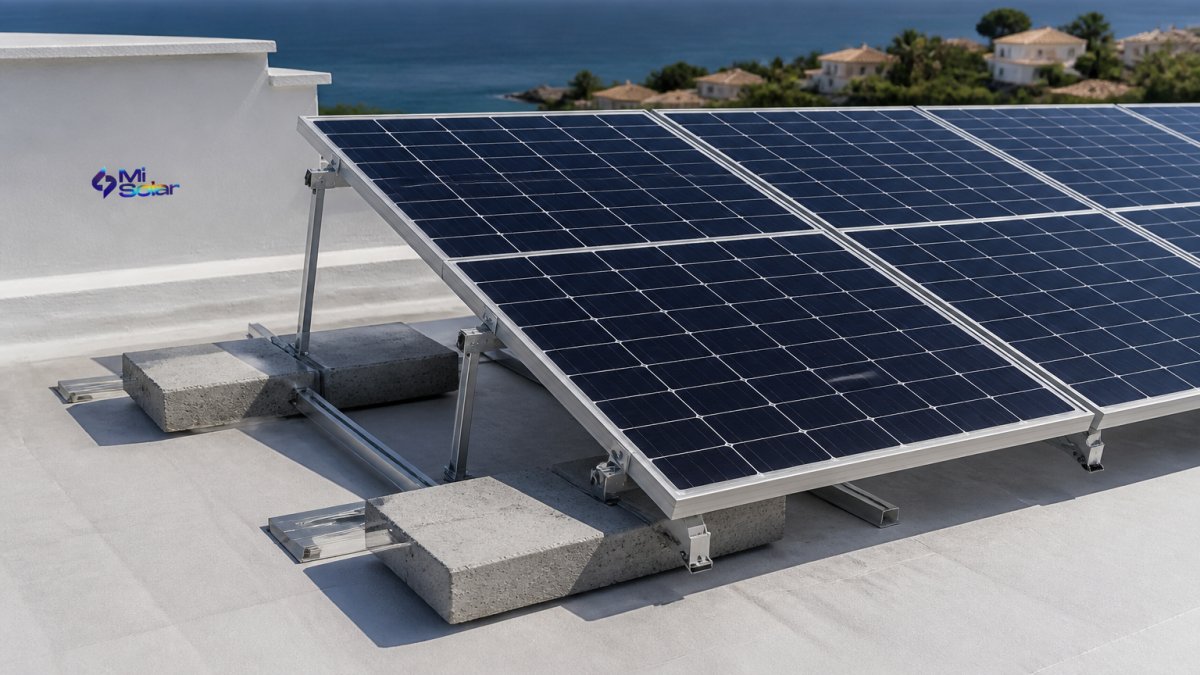
Weight is the catch. Ballast adds real load, so the roof structure has to carry it. A structural check comes before any layout decision.
Before you commit to a mounting and budget, our solar panel installation cost breakdown sets out the figures to weigh.
How Flat Roof Solar Panel Wind Load Changes the Layout
Flat roof solar panel wind load is the factor most homeowners never think about, and it decides more of the layout than tilt does. A raised panel on an exposed roof acts like a sail. Wind gets under the frame and tries to lift it.
Coastal roofs can face stronger and more frequent gusts, which changes the design:
- Lower tilt reduces the sail effect
- More ballast resists uplift at the edges and corners
- Edge setbacks keep panels away from the highest wind pressure zones
- Row position matters, because the first row takes the brunt
Spanish building rules require the mounting to be engineered for local wind conditions rather than copied from a catalogue. The Spanish Building Code sets the structural safety framework designers work within, and coastal exposure raises the requirement further.
Book a Flat Roof Solar Survey With MiSolar
The best flat roof solar panel layout comes from someone standing on your roof, not from a satellite image. Every rule above depends on your specific building, your shade, and your wind exposure.
MiSolar has completed over 300 installations, with a 5.0* rating. We handle engineering, permitting, procurement, and on-site works in-house. Alongside Residential Solar Installation and Solar PV Installation Services, we also fit EV chargers so the power your flat roof generates can go straight into the car.
For a Jávea property, local expertise in roof types, municipal requirements, and optimal panel orientations for the Costa Blanca North region matters. You can see how the full process runs in our Costa Blanca North installation walkthrough, review our residential solar installation services, or follow the 7 steps to solar panel installation in Javea.
Ready to find out what your flat roof can actually generate? Get a quote and we will survey it properly.
Frequently Asked Questions
What is the best direction to face solar panels on a flat roof in Spain?
South is the default for maximum annual yield across Spain. On a flat roof you can orient panels south with a tilt, or lay them almost flat and face them south with a slight lift. East or west orientations can spread generation across morning and evening, which suits holiday homes with afternoon air-conditioning loads. A survey should confirm the final direction against shading and your consumption pattern.
What tilt angle should flat roof solar panels have in Jávea?
A tilt of 25 to 35 degrees is the usual range for flat roof solar panel installations in this region, balancing annual yield against wind exposure. Steeper angles produce more in winter and shed rain better; shallower angles reduce wind load and row spacing. The exact figure depends on your roof height, the wind zone and how much space you have between rows, so it should be set during the design survey rather than guessed.
Can solar panels be installed on a flat roof without drilling?
Yes. A ballasted solar panel mounting system holds the array down with weighted blocks or trays instead of penetrating the waterproof membrane. This removes the main leak risk on flat roofs and is common on commercial and residential buildings. The system still needs an engineer's check that the roof structure can carry the added weight, and wind load calculations must confirm the ballast is heavy enough for the building's exposure.
How much space should be left between rows of flat roof solar panels?
Flat roof solar panel spacing depends on the tilt and the sun angle in winter. A common rule is to leave a gap of roughly two to three times the panel height when panels are tilted 25 to 35 degrees, so the front row does not shade the row behind at midday in December. On a tight roof, reducing the tilt to 10 to 15 degrees cuts the required gap and lets you fit more panels.
Your roof has one best layout, and it is worth getting right the first time. MiSolar designs each system around your shade, wind exposure, and consumption, then manages the permits and installation from start to finish. Get started with MiSolar and turn your flat roof into a system built for your home, not a template.