 how-to
What Is Shading Analysis for Solar Panels?
Last Updated: October 24, 2026
Quick Summary
Shading analysis for solar panels measures how much sunlight your roof loses to trees, buildings, chimneys and other obstructions, hour by hour, across a full year. It tells you what a roof can realistically produce before installation, because shade on one panel drags down the panels wired with it.
- Panels are wired in series into strings, so current flows at the rate of the weakest link.
- Walk the property at early morning, midday and late afternoon to note what casts shadow.
- Photograph each obstruction from the proposed panel position, not the ground, with date and time.
- A shade survey has a shelf life; ask for the horizon to be re-checked if over a year passes.
- Three values should prompt follow-up: winter shade loss far above annual average, a forecast with no uncertainty, and a horizon diagram that does not match your photos.
Table of Contents
- What Shading Analysis for Solar Panels Actually Measures
- How Shade Affects Solar Panel Output
- How a Shade Assessment Is Carried Out on Site
- Solar Panel Shade Analysis Tools: From Sun Path Apps to Irradiance Meters
- Reading a Solar Panel Shading Report
- How to Reduce Shading Losses Solar Panels Suffer From
- Book a Shade Assessment Before You Sign Anything
- Frequently Asked Questions
What Shading Analysis for Solar Panels Actually Measures
Shading analysis for solar panels measures how much sunlight your roof loses to trees, buildings, chimneys and other obstructions, hour by hour, across a full year.
The measurement looks at three things: where the sun sits over the year, which objects block it, and when those blocks overlap your panels.
A noon reading in July tells you almost nothing; the same roof in December may sit in shadow for hours. Good analysis captures both.
Hard Shade, Soft Shade and Diffuse Light
Hard shade is a solid block: a wall, a chimney, a tree trunk. It cuts output sharply and predictably.
Soft shade is partial and broken: thin branches, mesh, a distant antenna. It dims light rather than stopping it.
Diffuse light is the scattered brightness from a bright but hazy sky.
Knowing which type hits your roof changes the fix. Hard shade needs layout changes.
How Shade Affects Solar Panel Output
A shaded panel does not simply lose its own share of the power. It drags down the panels wired with it, the part most homeowners do not expect.
Panels are wired in series into strings. Current flows through the whole chain at the rate of the weakest link.
Bypass diodes inside the panels limit the damage by routing current around blocked sections. They help, but they are a safety net, not a cure.
Why One Shaded Cell Can Pull Down a Whole String
A panel is a grid of cells wired together. Shade one cell and it stops pushing current; the cells around it keep working, but the chain is only as strong as its weakest point.
This is called electrical mismatch. It is why a small shadow from a satellite dish can cost more output than its size implies.
Two design choices reduce mismatch:
- Optimisers on individual panels, which let each one work at its own rate
- Microinverters, which convert power at each panel instead of at one central inverter
Both cost more upfront. On a shaded roof, they often pay for themselves in recovered production.
How a Shade Assessment Is Carried Out on Site
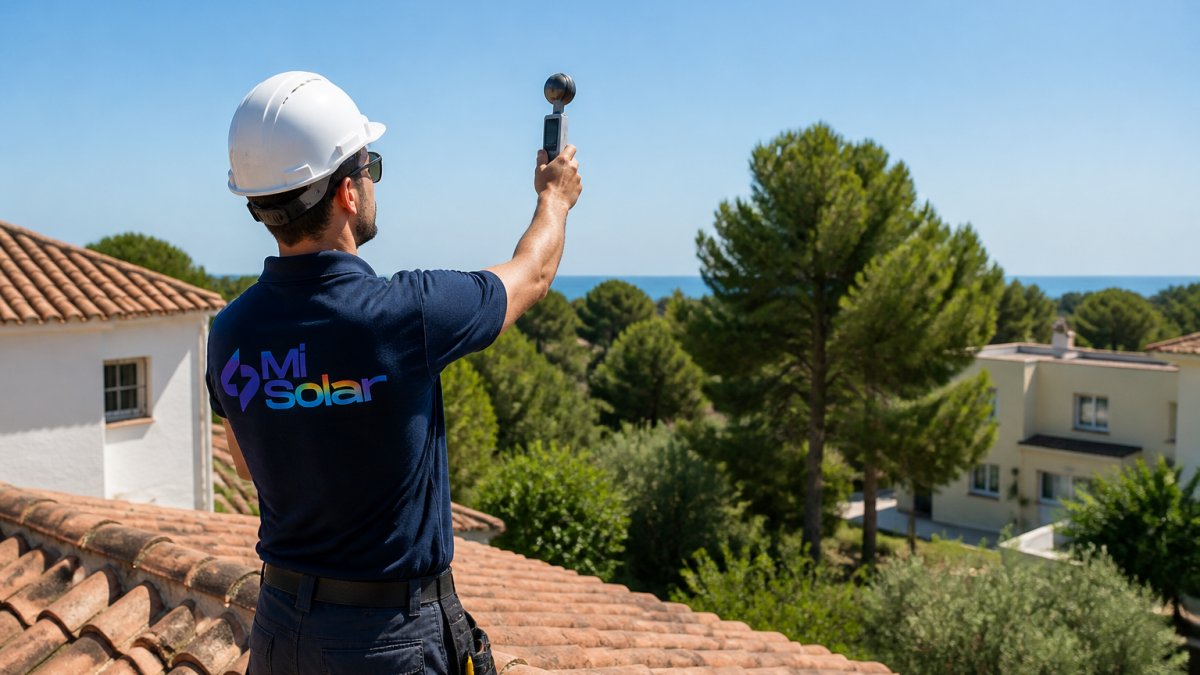
A site assessment takes a physical walk of the roof and the ground around it: the technician records obstructions, checks the panel mounting areas, and logs the sun's path against what stands in the way.
What to Inspect and Record Before the Visit
You do not need instruments for the first pass. Walk the property at three times of day, early morning, midday and late afternoon, and note what casts shadow on the proposed panel area. A four-column worksheet is enough:
- Obstruction: what it is (tree, chimney, parapet, aerial, water tank, neighbouring building, streetlight)
- Location: which side of the roof it sits on, and roughly how far from the panel area
- Timing: which hours and which months it appears to block the roof
Photograph each obstruction from the proposed panel position, not the ground: that shows the horizon the array will actually see. Note the date and time on each photo; a December photo and a June photo of the same corner tell very different stories.
What the Technician Measures On Site
The visit itself covers:
- Roof survey: pitch, orientation, usable area and fixing points
- Obstruction mapping: trees, neighbouring buildings, parapets, aerials, water tanks, and any planned construction you flag
- Sun path tracking: where the sun rises, peaks and sets across the seasons, checked against the actual horizon
A single reading at the centre of the roof is not enough on a roof with dormers, chimneys or split levels. Ask for readings at each distinct panel zone; one reading extrapolated is a sketch, not a measurement.
The Reproducible Workflow to Follow
- Pre-survey (you): complete the worksheet above and take dated photos from the panel position.
- Desktop check (installer): compare your notes against aerial imagery and a sun-path model to flag likely problem areas before travelling.
- On-site measurement (installer): take horizon and shade readings at each panel zone, at the proposed mounting height and tilt.
- Cross-check (both): compare the measured horizon against your photos and the desktop model. Disagreements are the most valuable part of the visit, they usually mean a tree has grown, a neighbour has built, or the model assumed a different roof plane.
- Record (installer): leave you with the raw readings, the assumptions, and the date of the survey, not just a headline percentage.
You can see how this feeds into a full design in our walkthrough of solar PV installation in Costa Blanca North, from roof assessment to commissioning.
Solar Panel Shade Analysis Tools: From Sun Path Apps to Irradiance Meters
Tools range from free phone apps to professional meters, and each answers a different question. Cheap options are useful for a first look but no substitute for an on-site reading.
| Tool type | What it does | Best for | Limits |
|---|---|---|---|
| Sun path app | Shows the sun's arc over your roof | Quick self-check | No real obstruction data |
| Solar pathfinder | Reflects the horizon onto a sun chart | On-site shade mapping | Manual, needs skill |
| Digital shade scanner | Photographs the skyline and logs obstructions | Detailed site surveys | Costs more |
| Irradiance meter | Measures actual sunlight at the panel spot | Verifying real conditions | A snapshot, not a year |
| Design software | Models the whole system in 3D | Layout and yield estimates | Depends on input accuracy |
A common mistake is trusting a satellite image. Aerial photos miss trees that have grown since, and they cannot show a neighbour's planned extension.
Reading a Solar Panel Shading Report
A solar panel shading report turns site readings into numbers you can judge, showing the shade pattern across the year rather than a single figure. The skill is knowing which numbers to trust, which to question, and which should send you back to the installer.
Look for these sections:
- Shade percentage by month, so you can see winter losses clearly
- A shade map showing which roof areas are hit and when
- Estimated annual yield in kWh, with the shade losses already deducted
The assumptions matter most. A report that assumes a clean, unshaded roof and then adds a small shade correction is telling you very little.
How to Interpret the Key Figures
Solar access is usually a percentage of the available sun the array can see over the year. A roof with clear horizons sits high; one hemmed by buildings and trees sits lower.
Annual shade loss is the percentage of production attributed to shading.
Sun-path diagrams show the sun's arc against the measured horizon.
Production forecasts should be given as a range or with a stated uncertainty, not a single confident number.
The Limits of Shade Tools and Estimates
Every shade estimate rests on assumptions, and honest reports say so. The main sources of uncertainty:
- Seasonal foliage: deciduous trees lose leaves in winter, so a summer survey can overstate shade in the cold months and understate it in summer. Evergreens do the opposite.
- Future growth and construction: a tree or a neighbour's planned extension can change the horizon after the survey.
- Weather variability: a single year's irradiance is not a guarantee of the next, and forecasts based on typical years will diverge from any given year.
A report that presents its output as exact overstates its precision; one that states its assumptions and gives a range gives you something you can plan around.
Ask how the predicted output is backed up. Our guide to solar system performance guarantees explains how monitoring and guarantees work when real output falls short of the forecast.
How to Reduce Shading Losses Solar Panels Suffer From
Reducing shading losses comes down to layout, hardware and a few low-cost habits. Some fixes cost nothing.
Start with the free options:
- Move panels to the clearest roof plane, even if it means fewer panels
- Trim or manage trees on your own land, within local rules
- Relocate aerials and satellite dishes away from panel areas
Then consider hardware:
- Optimisers or microinverters for roofs with unavoidable partial shading
- Panel layout that avoids the worst corners of the roof
- Higher-efficiency panels where usable space is tight
If shade is the main worry, our page on solar panels for shaded roofs covers which of these approaches actually delivers.
Watch out: cutting or heavily pruning a protected tree without permission can land you with a fine that dwarfs any energy saving.
Book a Shade Assessment Before You Sign Anything
Signing a solar contract without a shade assessment is the most common way homeowners end up disappointed.
Before you commit, ask any installer three questions:
- Can I see the shade report for my roof?
- What output do you predict, and what happens if it falls short?
- Which electrical design choices did you make because of shade?
If the answers are vague, walk away. Our list of questions to choose the right solar panel installer covers accreditation, technical design and legalisation in more detail.
At MiSolar, we handle the survey, the shade mapping and the system design in-house, so the team that reads your roof is the team that builds the system, whether that means residential solar installation and solar PV installation services or adding an EV charger installation alongside it.
For the technical rules behind grid connection and self-consumption in Spain, the official self-consumption guidance from IDAE sets out the framework, and UNE standards for PV installations cover the technical requirements installers must meet.
Frequently Asked Questions
My roof is shaded in the afternoons by the neighbour's trees. Will solar still work for me?
Often yes, but the design has to match the shade. A shading analysis maps exactly which hours and months those trees block, so the installer can put panels on the least affected roof plane, split them across separate strings, or fit optimisers to limit the loss. Afternoon shade is common on villas with mature gardens. The report tells you what share of annual yield you lose and whether the remaining production still justifies the investment.
Can solar panels work effectively in partial shade?
They can, with the right electrical design. Partial shading on a string system drags down the output of every module wired in series with the shaded one, because the current has to match. Bypass diodes and module-level electronics reduce that penalty, and separating shaded and unshaded panels onto different strings helps further. A shade study quantifies the loss before installation, so you know whether partial shade costs you 5% or 30% of annual production.
What is the difference between a solar shade and shading analysis?
A solar shade is a physical product, such as an awning, blind or screen that blocks sunlight from entering a building. Shading analysis is the survey and modelling step in solar panel design that measures how obstructions affect production on a specific roof. The two are unrelated despite the shared word. Shading analysis produces a report with sun paths, obstruction heights and estimated yield losses, which the installer uses to plan panel placement and string layout.
How accurate are shade analysis tools, and what are their limits?
Sun path apps and satellite modelling give a solid first estimate, but they cannot see every chimney, aerial or growing tree. On-site measurement with a Solmetric SunEye-style device or a fisheye photo taken at panel height is more reliable. Accuracy also depends on the weather data and assumptions fed into the simulation, so treat the yield figure as a range rather than a promise. Ask for the assumptions behind any shading report before you rely on the number.
Shade is not a reason to skip solar. It is a reason to measure first. Get a quote from MiSolar and we will assess your roof, map the shade and design a system around what your roof actually gets.