 blog
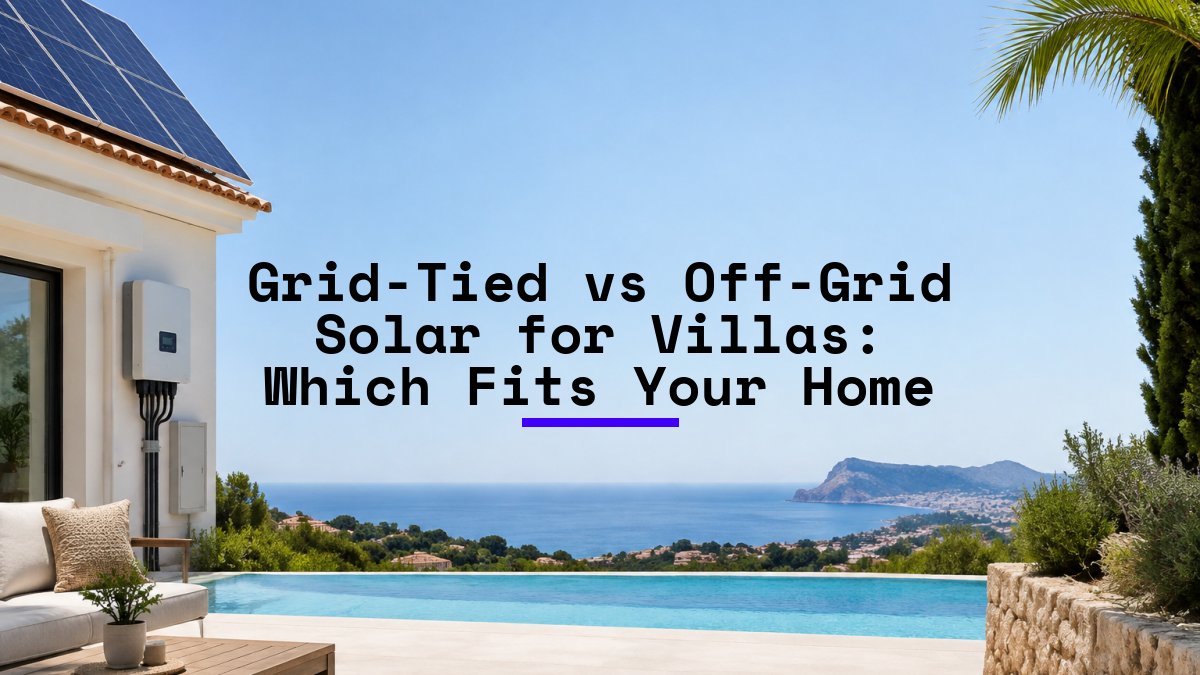
Grid-Tied vs Off-Grid Solar for Villas: Which Fits Your Home
Last Updated: November 24, 2026
Quick Summary
For most villas, grid-tied solar is the simpler route: panels, an inverter and the public network export surplus and supply power at night, with batteries optional. Off-grid systems add a large battery bank and drop the grid connection, tending to make sense on remote plots where a connection is impractical.
- A grid-connected system exports surplus to the grid and draws power at night.
- Off-grid villas need a large battery bank and no grid connection.
- Battery capacity should follow evening and night consumption, not array size.
- A hybrid system keeps the grid connection and adds battery storage and a backup circuit.
- Off-grid sizing must account for cloudy weeks, not just average days.
Table of Contents
- How Grid-Tied and Off-Grid Solar Systems Work for Villas
- Hybrid Solar System for Villas: The Middle Path
- Solar Batteries for Villas in Spain: Capacity, Backup and Outage Reality
- Frequently Asked Questions
How Grid-Tied and Off-Grid Solar Systems Work for Villas
Choosing between grid-tied solar and off-grid systems for villas comes down to one question: do you want the utility as your safety net, or replace it entirely? A grid-connected system uses panels, an inverter and the public network, exporting surplus and drawing power at night; a stand-alone system adds a large battery bank and drops the grid connection.
For most villas around Jávea, grid-tied is typically the simpler route; off-grid tends to make sense on remote plots where a grid connection is impractical. The right answer depends on your roof, consumption and tolerance for outages.
| Feature | Grid-Tied | Off-Grid |
|---|---|---|
| Battery required | Optional | Essential |
| Upfront investment | Lower | Higher |
| Outage backup | Only with batteries | Always |
| Surplus handling | Exported to the grid | Stored or wasted |
| Best for | Connected villas | Remote properties |
If you are weighing alternatives to a standard connection, our guide to alternatives to grid electricity for homes covers the options in more depth, and holiday-home owners comparing approaches will find the practical route in installing solar power for holiday homes in Spain. Spanish self-consumption rules, administered through the IDAE self-consumption guidance, set out how surplus generation is compensated.
Hybrid Solar System for Villas: The Middle Path
A grid-tied solar system for villas with hybrid storage keeps the grid connection but adds battery storage and a backup circuit, giving daily self-consumption savings plus power during an outage.
The trade-off sits between a physical home battery and a virtual battery scheme offered through your tariff; our comparison of home batteries vs virtual batteries in Spain breaks down which cuts bills more. Batteries do not automatically keep a house running during a blackout, backup needs specific wiring and a Normally Closed contactor.
Solar Batteries for Villas in Spain: Capacity, Backup and Outage Reality
Battery capacity should follow your evening and night consumption, not array size. Oversizing panels and undersizing storage leaves surplus exported for little return while the villa still draws from the grid after dark.
For sizing and backup design see our solar battery storage and backup power service, and to compare products read the 2026 home battery review. If you are planning the full package, our Residential Solar Installation and Solar PV Installation Services cover everything from array design to commissioning, and pairing the system with a Solar Pool Heater lets you put that generation to work on the pool without adding load to the battery bank.
Off-grid solar system sizing for a villa needs a wider margin: account for cloudy weeks, not just average days.
The gap between a system that pays for itself and one that disappoints usually comes down to the site audit, not the hardware. MiSolar handles engineering, permitting and installation in-house, designs around your actual consumption and roof orientation, and sets up monitoring so you can see performance from day one. Get started with MiSolar and cut your electricity bills to near zero.
Frequently Asked Questions
What is the difference between grid-tied and off-grid solar for a villa?
A grid-tied solar system stays connected to the utility grid and uses it as a buffer: surplus electricity is exported and shortfalls are imported. An off-grid system has no grid connection at all and must generate and store every kilowatt-hour the villa uses, so the solar array, inverter and battery bank all have to be sized for the worst week of the year. For most villas in Jávea and across Alicante, grid-tied solar is the lower-cost route to lower bills, while off-grid suits remote properties where a connection is impractical or unavailable.
Can a grid-tied solar system provide power during a blackout?
A standard grid-tied inverter shuts down when the grid fails, because regulations require it to stop feeding the network while crews are working. To keep essentials running during an outage you need a hybrid inverter with backup capability, a battery, and a Normally Closed contactor such as the Huawei SmartGuard to isolate the villa from the grid.
How do you size a solar battery for a villa in Jávea?
Start with the villa's evening and night consumption, not the size of the solar array. Add up what runs after sunset, factor in a reserve for cloudy days, and check the battery's usable capacity rather than its headline figure. For a holiday home occupied a few months a year, a smaller battery focused on evening self-consumption usually pays back faster than a large bank, while a family living in the property year-round needs more capacity to cover winter evenings.