 blog
Solar Panel Orientation: 10 Winter Energy Tips
Last Updated: November 21, 2026
Quick Summary
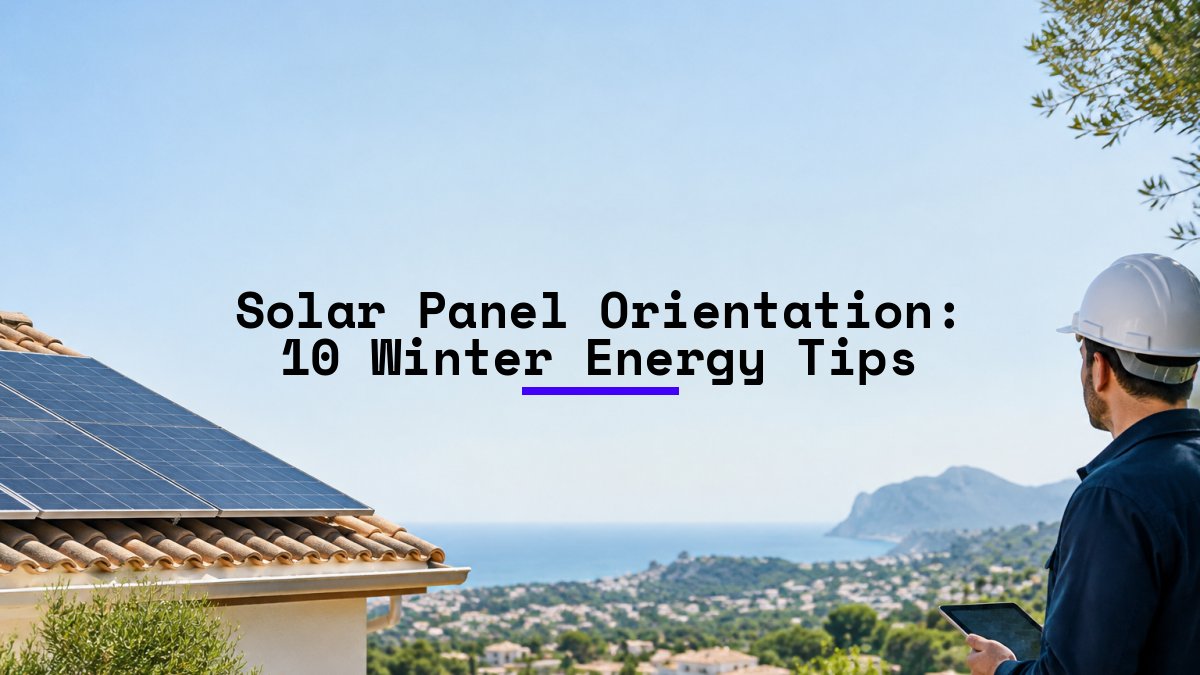
For winter energy, aim your solar panel orientation south and steepen the tilt to roughly 45 to 55 degrees in Spain so panels face the low sun more directly. Keep east and west panels on separate strings, check winter shading, and schedule heavy loads during the narrower winter daylight window.
- South is the best direction for solar panels in Spain, catching the low winter sun longest.
- A winter tilt of roughly 45 to 55 degrees helps panels face the low sun directly.
- East and west panels should sit on separate strings to avoid generation loss.
- One shaded panel can drag down others on the same string, so check winter shading first.
- Run heavy appliances during peak daylight and let the battery cover the evening.
Table of Contents
- Why Solar Panel Orientation Matters More in Winter
- The Best Direction for Solar Panels in Spain
- Setting the Right Solar Panel Tilt Angle for Winter
- Managing Solar Panel Shading in Winter
- Solar Battery Storage for Winter Evenings
- Booking a Winter Orientation Check with MiSolar
- Frequently Asked Questions
Why Solar Panel Orientation Matters More in Winter
Solar panel orientation is the single biggest factor you control over winter generation. Get it wrong, and your panels underperform for months.
Winter changes the game. The sun sits lower. Days are shorter. Shadows stretch further across roofs and gardens.
A well-oriented array can still produce solid output in December and January. A poorly oriented one drops off sharply. That gap matters when you want to cut bills and rely less on the grid.
Below, we break down the ten orientation tips that make the most difference in winter, from direction and tilt to shading and battery timing.
The Best Direction for Solar Panels in Spain
South is the best direction for solar panels in Spain, and winter makes that clearer than ever. A south-facing roof catches the low winter sun for the longest part of the day.
The Spanish government's guide to self-consumption confirms that orientation and tilt directly affect how much a system generates. That is why we check roof direction before quoting any job.
Why South Still Wins, and When East or West Makes Sense
South wins because it balances morning and afternoon sun. But it is not the only workable option.
- East-facing: strong morning output, useful if you run appliances early
- West-facing: better for evening use and battery charging
- East plus west split: spreads generation across the day
East and west panels should sit on separate strings. Mixing them on one string causes generation loss, because each panel's output affects the others in its string.
| Orientation | Best For | Winter Trade-off |
|---|---|---|
| South | Balanced all-day output | None significant |
| East | Morning-heavy use | Weak afternoons |
| West | Evening use, battery charging | Slow starts |
| East + West | Spread across the day | Needs separate strings |
Setting the Right Solar Panel Tilt Angle for Winter
The right solar panel tilt angle for winter is steeper than most people expect. In Spain, a winter tilt of roughly 45 to 55 degrees helps panels face the low sun more directly. That range is not arbitrary: it tracks the sun's lower noon elevation between December and February, when the sun sits roughly 25 to 30 degrees above the horizon at solar noon in the Jávea and Alicante area.
Flatter angles suit summer, when the sun is high. Winter rewards a steeper pitch. The trade-off is real: you cannot optimise for both seasons with a fixed mount. A roof pitched at around 30 degrees, common on many Costa Blanca North properties, is a reasonable year-round compromise.
How Tilt Changes Winter Yield on a Fixed Roof
Moving from a 30-degree pitch to a 50-degree pitch generally improves winter output modestly while reducing summer output. The exact figures depend on azimuth, row spacing, and shading. What matters is the direction of the trade-off: steeper helps winter, flatter helps summer, and a fixed roof has to split the difference.
Row spacing is part of the same calculation. On a steeper winter tilt, each row casts a longer shadow onto the row behind it, so you need more spacing between rows to avoid self-shading in December. On a constrained roof, that spacing can cost you panels, which is why a slightly flatter tilt with more modules sometimes beats a steeper tilt with fewer.
Should You Change the Angle Between Seasons?
For most homes, a fixed angle set for year-round performance is the practical choice. Adjustable mounts exist, but they add hardware cost and moving parts that need checking.
If your roof pitch already sits in a sensible range, a fixed mount is usually sufficient. On flat roofs, tilted frames can lift the array to a better winter angle, but the frame tilt and row spacing have to be designed together, because a steep frame on a flat roof is where self-shading appears in winter.
Watch out: a tilt angle chosen only for summer production can leave a fixed array noticeably weaker in December and January, when you most want the output.
Managing Solar Panel Shading in Winter
Winter shading is the silent killer of solar output. A bare tree or a neighbour's chimney can throw a long shadow across your roof when the sun is low.
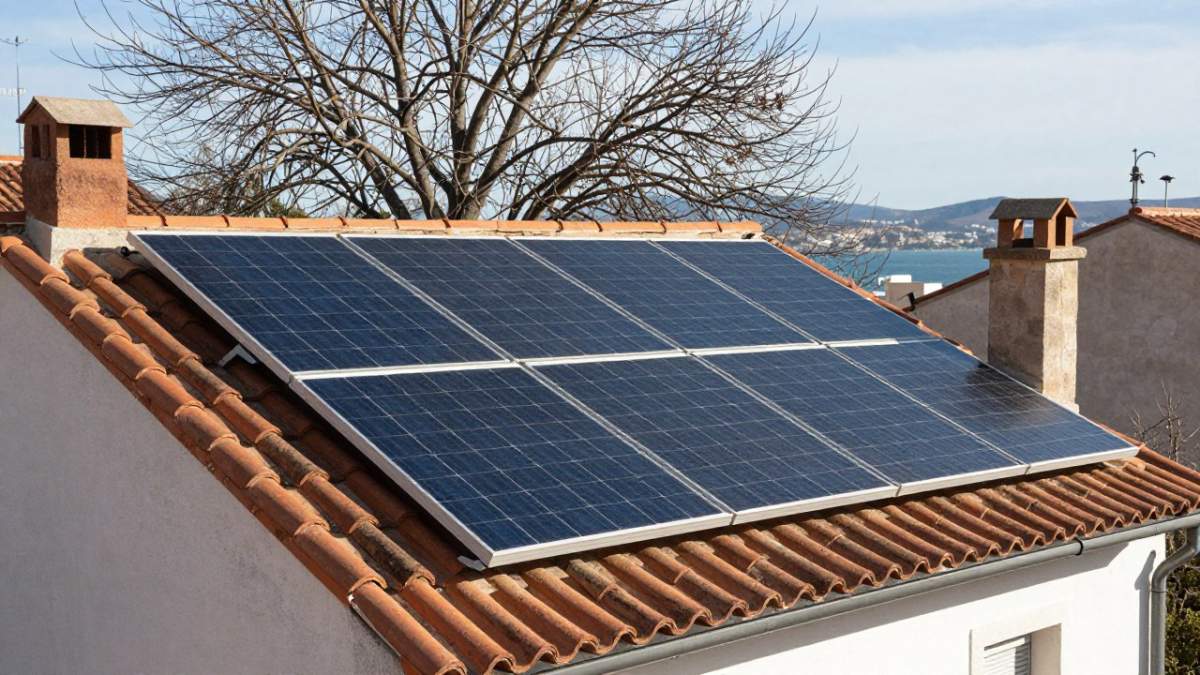
Shading hits harder than most owners realise. One shaded panel can drag down others on the same string. That is why a proper shading analysis matters before installation, not after.
If your roof is tricky, read our guide to solar panels for shaded roofs to see what actually works. Options include optimisers, micro-inverters, and smart string design.
Watch out: skipping a shading check in winter can leave you with an array that looks fine on paper but underperforms every December.
Solar Battery Storage for Winter Evenings
Solar battery storage for winter evenings turns daytime generation into night-time power. In winter, the sun sets early. A battery lets you use your own solar after dark instead of buying from the grid. That shift matters more in December and January, when the gap between a short generation window and a long evening load is at its widest.
Battery sizing is best matched to evening use rather than to a sales target. Systems can be specified so that storage can be added later. The practical question is not whether a battery is good in the abstract, but whether your winter evening load is large enough to absorb what the array produces during a short winter day.
Matching Winter Generation to Evening Load
A winter day on the Costa Blanca produces far less than a June day from the same array, and the usable window is compressed into fewer hours. A battery only helps if there is surplus daytime generation to store after the house has used what it needs.
A household that runs the washing machine, dishwasher, and water heating during the day will have less surplus to store than one that runs those loads in the evening. Shifting flexible loads into the solar window is often cheaper than adding battery capacity to cover them later.
Scheduling Loads Around Winter Sun
Good scheduling matters too. Run heavy appliances like the washing machine and dishwasher during peak daylight, then let the battery cover the evening.
Homes with a battery can also set the system to prioritise self-consumption over export, so stored energy is used at home rather than sold cheaply and bought back at a higher price.
Explore our solar battery storage and backup power service to see how it fits your home. If you are weighing brands, our home solar battery comparison walks through the options.
Watch out: sizing a battery to a summer surplus rather than a winter evening load can leave you with capacity that sits unused for months and a payback period that stretches well beyond what you expected.
Booking a Winter Orientation Check with MiSolar
A winter orientation check is the simplest way to confirm your array is set up to perform when it counts. We review direction, tilt, shading, and string layout on site.
Our team handles engineering, permitting, procurement, and on-site works in-house. Alongside Residential Solar Installation and Solar PV Installation Services, we also fit EV chargers so that solar generation can be used for EV charging.
You can see our solar panel installation service and get in touch to arrange a visit. We serve homeowners across the Costa Blanca North, and we are happy to answer questions before you commit.
Winter exposes every weakness in a solar setup, from a bad angle to a shadow you forgot about. Getting orientation right now means better output for years.
Frequently Asked Questions
Which direction should solar panels face in winter in Spain?
South remains the best direction for solar panels in Spain through winter, because a south-facing array catches the most sun across the low winter arc. East and west roofs still work, but they split production between morning and afternoon rather than peaking at midday. If your roof runs east-west, panels on both sides must sit on separate strings, since mixing orientations on one string drags the whole string down to the weakest panel's output.
What is the best solar panel tilt angle for winter in Jávea?
A steeper tilt than the summer optimum helps in winter, when the sun sits lower in the sky. Many installers in the area work with a fixed pitch somewhere between 30 and 40 degrees for year-round output, leaning towards the steeper end if winter production matters most to you. The exact figure depends on your roof pitch, the array's azimuth and whether the panels sit flush or on a raised frame, so it is worth having the roof assessed rather than copying a number from a forum.
Do solar panels produce enough electricity on cloudy winter days?
They produce less, but not nothing. Thin cloud cuts output noticeably while thick, low cloud can reduce it further, and winter days are shorter on top of that. The practical answer is to size the system around your annual consumption rather than a single grey week, and to shift heavy loads such as the washing machine or dishwasher into the middle of the day when generation peaks. A solar battery storage for winter setup then carries some of that midday production into the evening.
Can a battery help me use more of my winter solar energy?
Yes, and winter is where the case is clearest. Days are shorter, so more of your generation happens while you may be out, and a battery lets you store that midday output for the evening instead of exporting it cheaply and buying it back at full tariff. Size the battery against your evening consumption rather than the array's total output, and check that the inverter capacity leaves room to add one later if you are not ready to buy it now.